


In Energy, Food as Fuel, Holistic Care, Mineral Balancing

caffeine and sleepCaffeine and Sleep: You Fell Asleep Just Fine. Your Coffee May Still Be Changing Your Sleep

“I can drink coffee at night and go straight to sleep.” I hear some version of that sentence all the time, usually offered as proof that caffeine simply does not affect the person saying it. And maybe, in the most obvious sense, it does not. Maybe they really can have coffee in the evening, close their eyes, and drift off without lying awake for hours. But falling asleep is only one part of sleep.

That distinction is becoming harder to ignore as researchers look beyond whether caffeine keeps us awake and begin asking a more interesting question: what is the brain doing after we are already asleep? You can enter sleep. You can remain in bed for eight hours. You can wake without remembering any prolonged awakening. And the physiology of that sleep may still differ from what it would have been without caffeine.

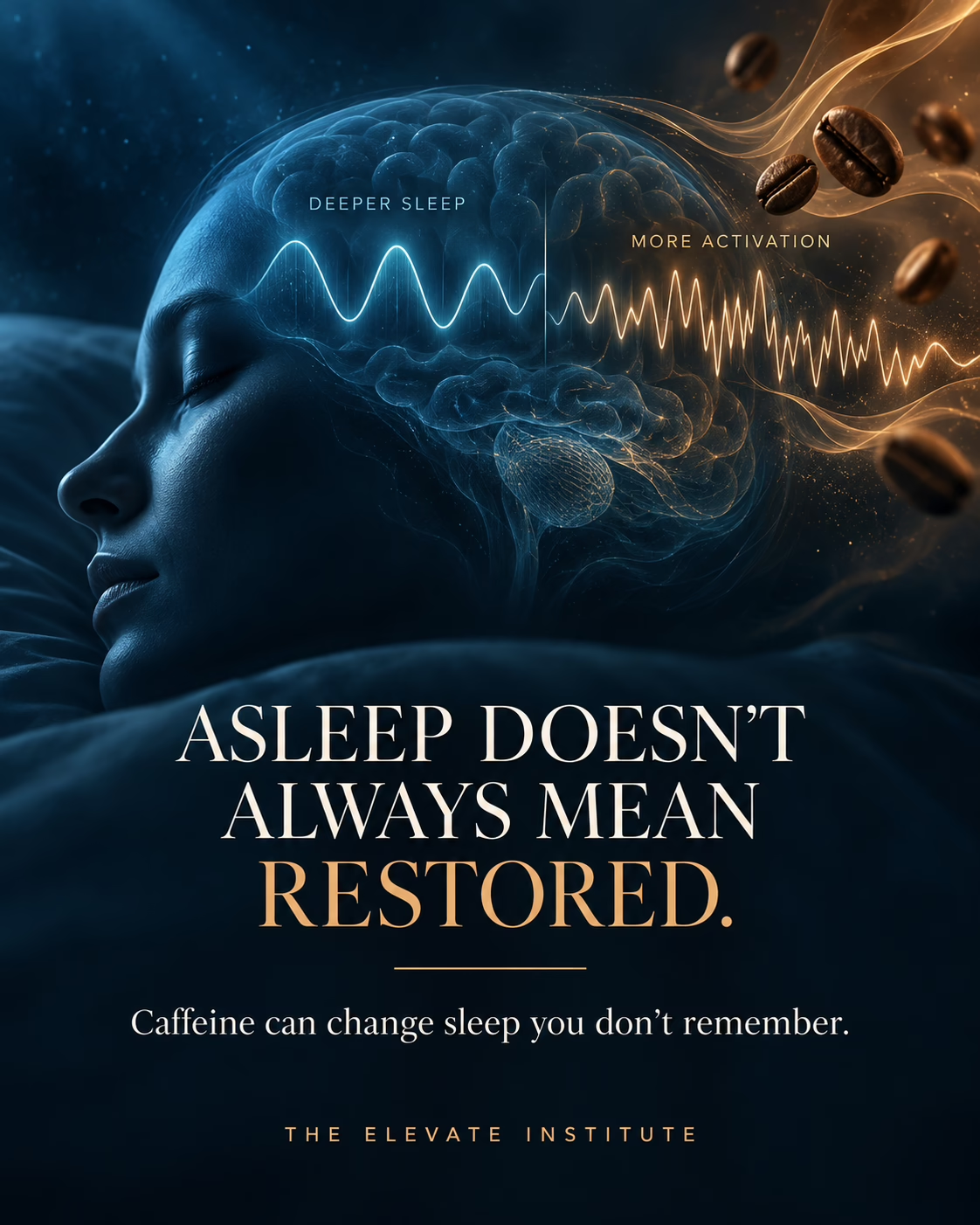
A 2026 systematic review of human sleep EEG research found that caffeine can alter the neurophysiology of sleep in ways consistent with reduced sleep depth and weaker homeostatic recovery. In some cases, quantitative EEG detected changes even when conventional sleep-stage measurements did not look dramatically different. In plain English, you do not necessarily have to be staring at the ceiling at midnight for caffeine to matter.

Falling Asleep and Recovering During Sleep Are Different Questions

Most of us judge sleep by consciousness. How long did it take me to fall asleep? Did I wake during the night? How many hours was I in bed? Do I remember sleeping badly? Those are useful questions, but they are not the whole story.

Sleep is an active physiological state, with changing patterns of brain activity unfolding throughout the night. One of those patterns is slow-wave activity, especially during non-rapid-eye-movement sleep. That activity is closely tied to the pressure for sleep that builds while we are awake and dissipates while we sleep.

Caffeine interferes with one of the major signaling systems involved in that process: adenosine. Adenosine accumulates during wakefulness and contributes to the feeling of sleep pressure. Caffeine primarily works by blocking adenosine receptors, which reduces the experience of that pressure and makes wakefulness easier. That is why coffee works. But the biology of adenosine does not suddenly stop mattering because your eyes closed.

Your Sleeping Brain May Still Know About the Coffee

Controlled sleep studies have shown that caffeine can change what the brain is doing during sleep. One study using EEG recordings found that 200 milligrams of caffeine shifted sleeping-brain activity toward greater neural excitation, particularly during NREM sleep. Other work has found dose-related reductions in EEG delta activity, a signal associated with deeper sleep.

The 2026 systematic review brought the broader literature together and reached a more nuanced conclusion than the usual “coffee is bad for sleep” headline. Caffeine does appear to alter sleep neurophysiology, but the size and significance of that effect varies widely depending on dose, timing, habitual use, age, circadian timing, and genetics.

That last part matters. This is not evidence that everyone needs to quit coffee. It is evidence that “I can fall asleep” is an incomplete caffeine experiment.

The Morning May Be More Informative Than Bedtime

The more useful question may actually be what happens the next morning. How do you feel when sleep is supposed to have done its work? Are you waking refreshed? Do you need caffeine immediately to feel functional? Are you getting what looks like enough sleep but still dragging through the morning? Does your sleep change when your caffeine timing changes? Does afternoon coffee seem completely irrelevant at bedtime but somehow correspond with poorer mornings?

Those questions move us out of ideology and into observation, because caffeine metabolism is highly individual. Some people can have an espresso after dinner and sleep without obvious difficulty. Others can have coffee at two in the afternoon and still feel wired at midnight. Genetics, age, habitual intake, circadian rhythm, dose, and timing all influence response.

So yes, the person who drinks coffee late and sleeps easily may genuinely respond differently from someone who is more sensitive. But there is another possibility. They may be less aware of the effect rather than completely unaffected by it. Those are not the same thing.

Where Self-Awareness Reaches Its Limit

This is one of the places where the limits of self-awareness become important. We talk often in holistic health about listening to the body, and that matters. Subjective experience contains information that no wearable, lab test, or algorithm can fully replace.

But it is equally important to acknowledge that the body does many things we cannot feel. You cannot accurately intuit your blood pressure. You cannot consciously monitor your oxygen saturation while you sleep. You cannot reliably feel changes in blood glucose without measurement. And you certainly cannot lie unconscious for eight hours while simultaneously evaluating the electrical architecture of your brain.

Sometimes the data sees something the person does not. Other times, the person feels something the data does not capture. Neither source of information deserves absolute authority.

That tension is one of the most interesting parts of True Holistic Healing. The point is not to choose between “trust your body” and “trust the data.” The better question is: what can each source of information actually tell me?

Before Blaming Coffee, Remember How Many Roads Lead to Fatigue

That distinction becomes especially important with fatigue, because fatigue is one of the easiest symptoms to oversimplify. You read an article about caffeine. You are exhausted. Therefore caffeine caused the exhaustion.

No.

Persistent fatigue can have many causes. Sleep apnea, insomnia, restless legs syndrome, narcolepsy, hormonal changes, chronic illness, medication effects, pain, mood disorders, and other conditions can all contribute to waking unrefreshed. Coffee is an interesting variable. It is not a universal diagnosis.

If someone is waking exhausted despite adequate time in bed, especially if there is loud snoring, gasping, witnessed pauses in breathing, significant daytime sleepiness, or other concerning symptoms, appropriate medical evaluation matters.

The useful thing about caffeine is not that it gives us one more culprit to blame. It gives us a variable we can actually test.

The Caffeine-Fatigue Loop Deserves Attention

And that brings us to a pattern that deserves attention: the caffeine-fatigue loop. You are tired, so you drink caffeine. Caffeine makes wakefulness easier. If caffeine then reduces sleep depth or alters sleep physiology in a susceptible person, morning recovery may be poorer. So you wake tired and drink caffeine again.

I am deliberately saying may, because the evidence does not establish that this cycle happens in every coffee drinker. But as a personal pattern, it is worth investigating. Not fearing. Not moralizing. Investigating.

Sometimes this is where health work becomes almost comically simple. A person buys a supplement, orders a hormone panel, buys a sleep tracker, starts researching cortisol, and wonders if they need to detox. Meanwhile, nobody has asked what time the last coffee was.

Sophisticated health work does not always begin with a sophisticated intervention. Sometimes it begins with a better question.

Don’t Confuse a Stimulant With Energy

There is another distinction here that matters even more. Caffeine can make you feel less sleepy. That is not necessarily the same thing as creating physiological restoration. The two experiences can feel identical in the moment, especially at ten in the morning, but they are not conceptually the same.

A stimulant can alter your perception of fatigue without necessarily correcting whatever created the fatigue in the first place.

That leads to a question worth sitting with: are you creating energy, or borrowing alertness?

That is not a literal biochemical description. It is a useful way to think about the difference between feeling more awake and actually being restored.

Research adds nuance here too. A 2026 Mendelian-randomization study found evidence that higher caffeine consumption reduced daytime sleepiness, but it did not find clear causal evidence that caffeine consumption or metabolism caused insomnia or changed sleep duration.

Again, the answer is not “coffee is bad.” The answer is that the biology is more complex than our slogans.

Run the Experiment Instead of Joining a Caffeine Religion

Which is why I would rather see someone run an experiment than join a caffeine religion.

If you are curious, move your last caffeine earlier for a couple of weeks. Keep the rest of your routine reasonably stable. Notice what happens. How long does it take you to fall asleep? Do you wake during the night? How do you feel in the morning? How quickly do you reach for caffeine after waking? What happens to daytime energy? What happens to your sleep tracker, if you use one?

Then compare.

If something changes, that is useful information. If nothing changes, that is useful information too.

No moral judgment about your coffee required.

Sometimes the Symptom Isn’t Where the Disruption Happened

This is where the broader True Holistic Healing lesson appears. We tend to look for the cause of a symptom in the same place the symptom appears. Tired in the morning? We examine the morning. Dragging in the afternoon? We examine lunch. Unable to focus? We examine the moment we cannot focus.

But physiology has a timeline.

Sometimes the symptom arrives hours after the influential event has already disappeared from conscious attention. That does not mean yesterday’s four-o’clock coffee caused today’s eight-o’clock fatigue. It means the timeline is worth examining.

Sometimes the symptom is not where the disruption happened.

And that is a much larger principle than caffeine. Health is not a collection of isolated moments. What happens now can affect what happens later. Sleep affects tomorrow. Tomorrow’s behavior affects tomorrow night. Stress changes appetite. Appetite changes food choices. Training changes recovery. Medications change physiology. Relationships affect sleep. Environment affects exposure. The body carries sequence.

So when a symptom does not make sense in the moment, widening the timeline may reveal more than adding another theory. That is what good holistic investigation should do. Not invent increasingly exotic explanations. Widen the field until the pattern becomes visible.

If you sleep all night and still wake tired, perhaps coffee is part of that pattern. Perhaps it is not. The point is not to decide before you look. The point is to become curious enough to find out.

Because “I slept” is useful information.

But it may not be the final question.

Recommended Posts
chronic stress