

Fatigue Is a Symptom. It Is Not an Explanation.
There is a particular kind of frustration that comes with being exhausted for a long time.
Eventually, everybody wants the fatigue to name its culprit.
Maybe it is stress. Maybe hormones. Maybe inflammation. Maybe mitochondria. Maybe iron. Maybe trauma. Maybe Long COVID. Maybe adrenal fatigue. Maybe you need to exercise more. Maybe you need to exercise less. And, naturally, somewhere on the internet someone is waiting to sell you the powder that allegedly settles the matter.
The problem is that fatigue does not tell us what caused fatigue.
New research offers a fascinating illustration of why.
Researchers studying five seemingly different illnesses—myalgic encephalomyelitis/chronic fatigue syndrome (ME/CFS), Long COVID, post-traumatic stress disorder (PTSD), rheumatoid arthritis and multiple sclerosis—recently looked beyond individual genes and examined the regulatory networks connecting them.
At the individual-gene level, the conditions showed surprisingly little overlap.
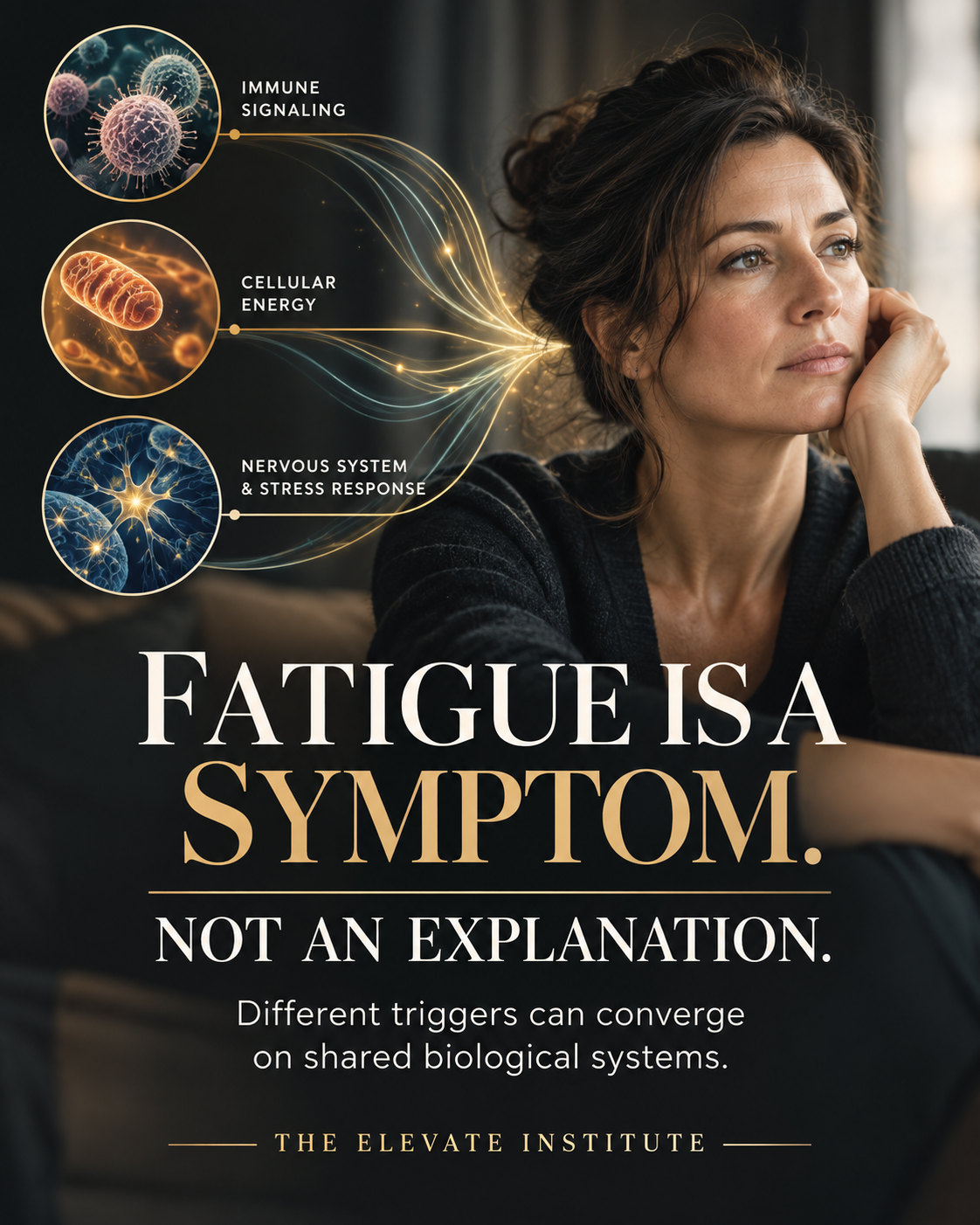
When researchers looked at the networks in which those genes operate, however, a different picture emerged. The conditions appeared to converge around biological systems involving immune regulation, metabolism and cellular energy, neurological signaling and stress-response pathways. Springer
The researchers called the findings something approaching a “biological unifying theory of fatigue.”
That is an irresistible phrase.
It is also considerably more certainty than the study can currently carry.
What the Research Actually Found
The paper, published in the Journal of Translational Medicine, used an approach based on three-dimensional genome architecture.
DNA is not laid out inside our cells like a very long instruction manual sitting neatly on a shelf. It folds. Regions that are distant from one another in the linear genetic sequence can come into physical proximity and influence gene regulation.
The researchers used a proprietary platform developed by Oxford BioDynamics to examine those relationships. They combined previously published genomic data from several conditions with 3D genomic information derived from earlier ME/CFS research. ScienceDaily
Their analysis found little direct gene-level overlap among several of the illnesses. But when the researchers mapped the genes into broader functional networks, they found substantially more convergence.
That distinction is important.
The finding is not that rheumatoid arthritis, PTSD, Long COVID, ME/CFS and multiple sclerosis are secretly the same disease.
They are not.
Their triggers, diagnostic criteria, disease processes and clinical courses differ.
The intriguing possibility is that different disturbances can eventually place pressure on some of the same regulatory systems.
Think less “one hidden disease” and more “different roads reaching some of the same intersections.”
That is a much more interesting idea.
The Body Does Not Respect Our Filing Cabinets
Medicine has very good reasons for dividing itself into specialties. Expertise matters.
Bodies, unfortunately, have never shown much respect for departmental boundaries.
The immune system communicates with the nervous system. Hormonal signaling affects metabolism. Sleep influences immune function. Psychological trauma can produce measurable physiological changes without therefore becoming the explanation for every physical illness. Infection can alter immune behavior. Autoimmune disease can affect energy, cognition and mood.
The systems remain distinguishable, but they are not isolated.
That is one reason the new study caught my attention.
Its central observation is not especially radical from a whole-person perspective: different initiating events may eventually influence overlapping biological networks.
What is novel is the attempt to identify that convergence through 3D genomic architecture.
The authors identified network relationships involving immune and inflammatory signaling, mitochondrial and metabolic processes, and neuroendocrine/stress-response pathways. Springer
But this is where we need to keep our scientific footing.
A computationally identified network is not proof that the network caused an individual patient’s fatigue.
It is not proof that manipulating one component will make that patient well.
And it is not yet a routine clinical test telling us why someone is exhausted.
Those steps require substantially more evidence.
“Your Labs Are Normal” Does Not Mean Fatigue Is Imaginary
Persistent fatigue occupies an uncomfortable place in health care because it is simultaneously common, nonspecific and sometimes profoundly disabling.
ME/CFS demonstrates the problem particularly well.
The Centers for Disease Control and Prevention describes ME/CFS as a serious multisystem illness. Its defining features include substantially reduced ability to perform previous activities, profound fatigue not relieved by rest, unrefreshing sleep and post-exertional malaise—the worsening of symptoms after physical or mental exertion. Cognitive impairment and orthostatic intolerance are also common. CDC
There is currently no confirmatory laboratory test for ME/CFS. Diagnosis requires medical history, examination, appropriate laboratory evaluation and consideration of other illnesses that could explain the symptoms. CDC
That fact deserves more attention than it gets.
The absence of one definitive marker does not mean the absence of biology.
It means our measurement is incomplete.
But the opposite mistake is equally dangerous: incomplete measurement does not give us permission to fill the gap with whatever explanation we prefer.
That is where “root cause” language can become surprisingly unscientific.
The Root-Cause Trap
People living with chronic symptoms understandably want an answer.
So do practitioners.
That creates a powerful temptation to find the thing.
The infection.
The trauma.
The toxin.
The mineral.
The hormone.
The mitochondria.
The nervous system.
But complex chronic illness may not always behave like a weed with one root waiting to be pulled.
Sometimes the initiating event and the maintaining conditions are different.
An infection may have passed while immune dysregulation remains. A period of overwhelming stress may have ended while sleep, behavior and physiology continue to reflect its aftermath. A nutrient deficiency may be corrected while another constraint remains. A disease may have a known diagnostic name while the degree of fatigue experienced by two people with that disease differs enormously.
This new genomic research does not prove that model.
But it does give us another reason to take network biology seriously.
And that leads to a more useful clinical question.
Not simply:
What causes fatigue?
But:
What is limiting this person’s capacity now?
That question leaves room for investigation instead of prematurely deciding which system deserves all the blame.
Fatigue and Capacity Are Not Quite the Same Thing
I find the word capacity useful because it changes what we notice.
Fatigue describes an experience.
Capacity asks what the person can actually produce, sustain and recover from.
Can she think clearly for three hours and then collapse?
Can she exercise but require several days to recover?
Does sleep restore her?
Does standing make symptoms worse?
Did her tolerance for ordinary activity change after an infection?
Is she exhausted but wired at night?
Does food alter her energy?
Are there cardiovascular, endocrine, nutritional, neurological, autoimmune, medication-related or sleep-related factors that require conventional medical evaluation?
These distinctions matter.
For someone with possible ME/CFS, for example, simply prescribing progressively more exercise can be inappropriate. Post-exertional malaise is a defining feature of the illness, and both CDC guidance and the UK’s National Institute for Health and Care Excellence emphasize recognizing activity-related symptom exacerbation. CDC
“Push through it” is not sophisticated health advice.
Neither is “take this supplement because fatigue means your mitochondria are broken.”
Both skip the investigation.
Similar Symptoms Do Not Require Identical Stories
This may be the most useful lesson in the new research.
We tend to reason from similarity:
These people are all exhausted, therefore the same thing must be wrong.
But the study suggests something subtler.
Different diseases may have very little overlap at one biological level and still intersect at another. Springer
That means two apparently contradictory ideas can both be true:
The origin of a person’s illness matters.
And:
Different origins may eventually affect some of the same systems.
That is very close to how I think about True Holistic Healing.
Whole-person work does not mean declaring that everything causes everything. That is not holistic; it is vague.
It means resisting the urge to amputate one system from the rest of the person simply because our professional language divided them into separate chapters.
The question is not whether the physical, mental, emotional, relational, behavioral and environmental parts of a life interact.
They already do.
The useful work is determining which relationships matter in this case, at this moment.
When Fatigue Deserves Investigation
New or persistent fatigue deserves appropriate medical evaluation, particularly when it is substantial, worsening or accompanied by other concerning symptoms.
There are many potential contributors to fatigue, and some require diagnosis and medical treatment. ME/CFS itself is not diagnosed simply because someone has been tired for six months. The CDC describes a specific constellation involving functional impairment, post-exertional malaise, unrefreshing sleep and cognitive impairment and/or orthostatic intolerance, alongside evaluation for other explanations. CDC
So this article is not an invitation to self-diagnose a complicated chronic disease.
It is an invitation to stop treating the word fatigue as though it were already a diagnosis.
Start With Information, Not Another Guess
This is where REVEAL can become useful for the person who has moved beyond “What supplement gives me energy?”
REVEAL uses hair mineral analysis to examine an individual mineral pattern as one part of a broader physiological picture. It is not a diagnostic test for ME/CFS, Long COVID, PTSD, multiple sclerosis, rheumatoid arthritis or mitochondrial disease, and it does not replace medical evaluation.
Its value is different.
It gives us more information about the person who is fatigued rather than prescribing from the symptom alone.
That distinction matters to me.
Because if emerging research continues to show us that chronic symptoms can arise through complex, interacting networks, the future of personalized health will not be found in making faster guesses.
It will be found in becoming better investigators.
Fatigue is real.
Fatigue can be profound.
Fatigue can change a life.
But fatigue is still a symptom.
The interesting question begins after we stop pretending it is the explanation.
References & Documents Cited
Hunter E, Alshaker H, Vugrinec D, et al. Beyond genes: EpiSwitch® and Orion platform-powered 3D genome architecture biomarkers reveal shared biology across ME/CFS, long COVID, PTSD, rheumatoid arthritis, and multiple sclerosis. Journal of Translational Medicine. 2026;24:1134. DOI: 10.1186/s12967-026-08874-9. Springer
Read the peer-reviewed study
Science Media Centre. Expert reaction to study investigating shared biological mechanisms between ME/CFS, Long COVID, PTSD, Rheumatoid Arthritis, and Multiple Sclerosis. September 3, 2026. Science Media Centre
Read independent expert reaction
Centers for Disease Control and Prevention. Symptoms of ME/CFS. CDC
CDC ME/CFS symptoms guidance
Centers for Disease Control and Prevention. Diagnosing ME/CFS. CDC
CDC diagnostic guidance
National Institute for Health and Care Excellence. ME/CFS: diagnosis and management — Recommendations. Nice
NICE ME/CFS guideline
FAQ: Can chronic fatigue have more than one cause? Yes. Fatigue is nonspecific, and appropriate medical evaluation considers multiple possible explanations rather than diagnosing from fatigue alone. CDC
Is chronic fatigue the same as ME/CFS? No. ME/CFS has specific diagnostic features including substantial functional impairment, post-exertional malaise and unrefreshing sleep, plus cognitive impairment and/or orthostatic intolerance. CDC
What is post-exertional malaise? It is worsening of symptoms following physical or mental activity that previously would have been tolerated; recovery can take days, weeks or longer. CDC
Does the new genomic study prove a single cause of chronic fatigue? No. It identified computational network convergence across several different conditions. Independent commentary has cautioned that describing the finding as a unifying theory is premature.