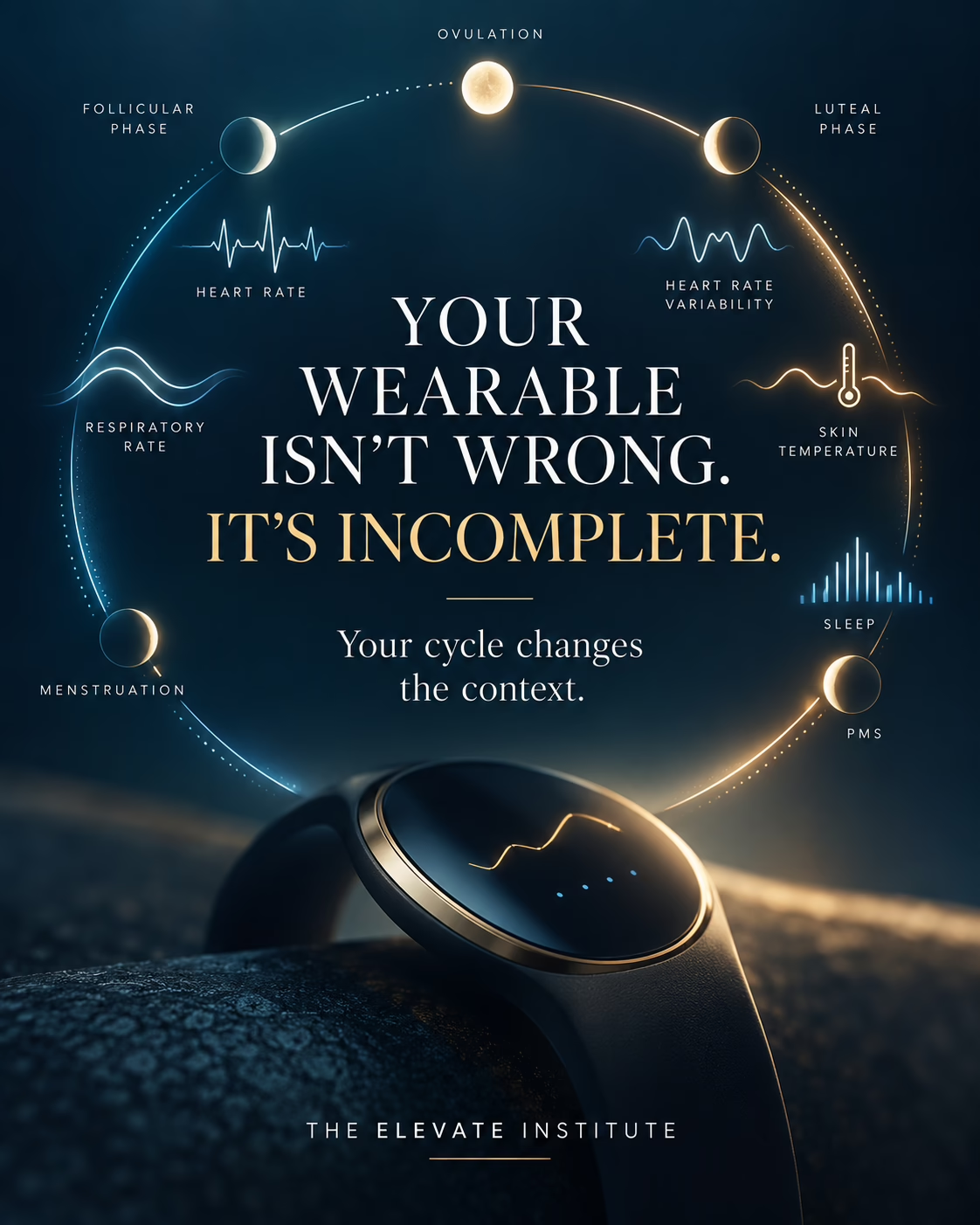



Your Wearable Says You’re Not Recovered. But What Is It Actually Measuring?
You wake up feeling reasonably good.
Then you look at your wrist.
Apparently, you are a disaster.
Your heart-rate variability is down. Your resting heart rate is up. Your recovery score has fallen into whatever color your particular device reserves for perhaps rethink your life choices today.
Suddenly you don’t feel quite so good anymore.
Wearable technology has given us access to physiological information that once required a laboratory, a clinic or considerably more inconvenience than sleeping with a watch on.
That is remarkable.
But there is a distinction we need to get much better at making:
Measurement is not meaning.
A fascinating large-scale study of menstrual cycles and wearable data makes that problem unusually visible.
Researchers from Stanford and WHOOP analyzed more than 1.29 million days of data from 2,596 women who recorded 42,759 menstrual cycles. The devices measured resting heart rate, heart-rate variability, respiratory rate, skin temperature, blood oxygen and sleep. The peer-reviewed research was published in npj Digital Medicine and has received renewed attention this month through Stanford and WHOOP. Stanford News
What they found should interest anyone wearing a device that claims to tell them something about their readiness, stress or recovery.
Because physiology moves.
Your baseline isn’t as still as you think
We tend to imagine a baseline as a line.
Here is your normal resting heart rate.
Here is your normal HRV.
Here is your normal temperature.
Deviation means something happened.
But human physiology isn’t graph paper.
The researchers created daily profiles of biometric changes across menstrual cycles and found systematic variation in several measures. Importantly, the magnitude of some changes differed depending upon cycle length. Nature
Stanford offers a useful example.
Imagine waking to find that your resting heart rate has increased and your HRV has decreased. Your device interprets those numbers as poorer recovery, so perhaps you cancel a demanding workout.
But menstrual-cycle phase can influence those same signals.
So can sleep.
And that creates a problem.
The device may have measured the signal correctly while your interpretation of the signal is wrong.
That distinction matters far beyond fitness.
Sleep changes the picture again
The study also explored sleep.
At the population level, shorter sleep was associated with greater variation in cycle length. Greater night-to-night variation in sleep duration was also associated with more variable cycle lengths. Nature
There was an especially interesting within-person component.
Researchers identified people whose sleep behavior changed during the study, allowing them to compare the same individual under different sleep conditions rather than simply comparing one group of people with another.
A 10% decrease in weekly sleep duration was associated with about a 1.2% increase in resting heart rate, along with changes in respiratory rate, skin temperature, blood oxygen and HRV. These sleep-related biometric shifts occurred largely regardless of menstrual-cycle phase. Nature
Now consider what your wearable sees.
Heart rate changed.
HRV changed.
Temperature changed.
Sleep changed.
Cycle phase changed.
The measurement may be perfectly legitimate.
But what caused what?
The watch cannot necessarily answer that.
Neither, frankly, can an Instagram carousel.
The danger isn’t bad data. It’s premature meaning.
This is where our relationship with health technology becomes philosophically interesting.
We tend to divide health information into two categories:
objective data and subjective experience.
The numbers are presumed to be factual.
The person is presumed to be interpretive.
But a number without context requires interpretation too.
A resting heart rate of 72 is a measurement.
Whether 72 means excellent recovery, illness, hormonal change, dehydration, medication response, sleep disruption, emotional stress, training adaptation or absolutely nothing important depends upon context.
That leads to one of the questions I think we’re going to need much more often as wearable medicine expands:
Is the signal abnormal—or is the context different?
Those are not the same question.
And this is where True Holistic Healing becomes unexpectedly relevant to our increasingly technological health culture.
Holistic does not mean rejecting data because intuition is somehow more enlightened.
It means refusing to remove the data from the person who produced it.
Your body is not a collection of independent dashboards
Menstrual physiology provides an unusually clear example because the cycle creates predictable biological variation.
But the principle is much larger.
Your sleep affects tomorrow.
Tomorrow’s stress can affect tomorrow night.
Training affects recovery.
Food affects glucose.
Illness affects heart rate.
Medication affects physiology.
Relationships affect behavior.
Behavior affects sleep.
Your environment changes exposure.
Your emotional state can influence appetite, movement, sleep and perception.
And all of those things are occurring inside one person at the same time.
This is why I resist the popular version of holistic health that draws three circles labeled mind, body and spirit and calls the work complete.
The circles were never separate.
A wearable adds another layer of information to an already interconnected system. It does not magically separate the variables.
In fact, as our measurements become more precise, our interpretations may need to become less simplistic.
That is the paradox.
More data should create more curiosity, not more certainty.
When your recovery score starts running your life
There is another layer here worth examining.
Wearables don’t merely measure behavior.
They can change it.
You wake feeling energetic but receive a poor recovery score. Do you trust your experience or your device?
You sleep badly but receive a surprisingly good score. Does that change how you interpret your fatigue?
You see your heart rate rise and become anxious. Anxiety raises your heart rate further.
Now the measurement has entered the system it was measuring.
This doesn’t make wearables useless. Quite the opposite.
Longitudinal information can help reveal patterns that memory misses. The menstrual-cycle study itself demonstrates the extraordinary research possibilities created by continuous real-world measurements. A peer-reviewed perspective published yesterday argues that wearable sensors could play an important role in more proactive and preventive healthcare through continuous physiological and behavioral monitoring. Nature
But useful tools still require wise users.
A thermometer tells you your temperature.
It doesn’t know the story of your fever.
A glucose monitor tells you what happened to glucose.
It doesn’t know everything that produced the response.
A wearable tells you what its sensors detected and what its algorithm inferred.
Those are three different levels of information.
We should learn to recognize them.
Menstrual cycles have been treated as noise for too long
There is another reason this research matters.
Women’s physiology has historically been underrepresented in biomedical research, and menstrual-cycle variation has sometimes been treated as an inconvenient variable rather than something worthy of investigation in its own right.
This study begins filling part of that gap.
The researchers generated daily reference profiles for resting heart rate, HRV, respiratory rate, skin temperature and blood oxygen across cycles, ages and cycle lengths. Nature
That’s useful precisely because it acknowledges that physiology changes.
“Normal” can contain rhythm.
But we should also resist swinging too far in the opposite direction.
The study does not prove that every change in a woman’s wearable data is hormonal.
It does not establish that poor sleep causes irregular periods.
It does not mean a concerning heart-rate change should be dismissed because someone is in a particular cycle phase.
And it does not include people reporting hormonal contraception, pregnancy or perimenopause/menopause, so its findings should not simply be extrapolated to those populations. Nature
Context expands investigation.
It should never become an excuse to stop investigating.
What should you do with all this data?
Become a better observer.
Instead of asking only:
“Is this number good or bad?”
Try asking:
What else was happening when it changed?
Where am I in my cycle?
How have I slept this week?
Did my training change?
Am I becoming ill?
Did I travel?
Did I change medication or supplements?
Has my appetite changed?
What is happening emotionally or relationally?
Is this a one-day deviation—or a persistent pattern?
Do I actually feel different?
Has anything concerning appeared that deserves medical evaluation?
This isn’t about constructing a personal diagnostic theory from your smartwatch.
It’s almost the opposite.
It’s about refusing to diagnose yourself from a single number.
The technology is getting better. Our questions need to keep up.
We are entering a fascinating period in health.
Your watch can see things you cannot feel.
Your continuous glucose monitor can reveal responses you would never have noticed.
Your sleep tracker can expose patterns your memory smooths over.
Soon, consumer devices will measure considerably more.
I welcome that.
But the future of health should not be a collection of increasingly sophisticated devices telling increasingly anxious humans what every fluctuation supposedly means.
The better future is one in which better measurement produces better questions.
Your wearable isn’t necessarily wrong.
Your body isn’t necessarily contradicting it.
The missing piece may simply be context.
And context is where patterns become meaningful.
If you’re beginning to notice that your symptoms, habits, physiology and life circumstances seem to be telling several stories at once, The Elevate’s Compass is designed as a place to begin exploring the larger terrain.
Not because every signal needs an explanation.
Sometimes it needs a better question first.
External sources: Original npj Digital Medicine study; Stanford research summary; PubMed record; September 19 peer-reviewed wearable-health perspective.
FAQ: Does HRV change during the menstrual cycle? Yes; this study documented daily HRV variation across cycles, with patterns influenced by cycle length. Can your menstrual cycle affect your resting heart rate? Yes, systematic variation was observed across cycle phases. Can poor sleep affect menstrual-cycle regularity? Shorter and more variable sleep was associated with greater cycle variability, but this observational evidence does not establish simple causation. Should I ignore a poor recovery score during certain cycle phases? No. Cycle phase is one piece of context, not an explanation for every abnormal reading. Can a wearable diagnose hormonal problems? Consumer wearable metrics may reveal patterns, but these data alone do not diagnose hormonal or menstrual disorders. Nature
Discover more from The Elevate Institute
Subscribe to get the latest posts sent to your email.