

Menopause Is Not a Supplement Prescription
There is apparently a moment somewhere around your mid-forties when the supplement industry decides it knows you personally.
You have crossed an age threshold. Perhaps your periods have changed. Maybe you are sleeping badly, running hot, feeling tired, noticing changes in mood or wondering what is happening to your body composition. You begin searching for information and suddenly every advertisement seems to have received your medical chart. There are menopause multivitamins, menopause gummies, menopause mushroom blends, menopause complexes, hormone-balance formulas and botanical concoctions with ingredient lists long enough to require their own table of contents.
The promise is wonderfully efficient: you are a woman of a certain age, therefore this is what you need.
That premise deserves considerably more scrutiny than it usually receives.
A consumer investigation making headlines this week examined 26 supplements marketed specifically for menopause, perimenopause or women over 45. Nutrition experts at Which? assessed more than 78 active ingredients and compared formulations, doses and existing evidence. Their conclusion was not that every supplement was worthless. It was that the products varied enormously, some ingredients had far better evidence than others, and some appeared in amounts unlikely to reproduce the effects reported in research. Some of the specialist formulations also cost dramatically more than ordinary multivitamins. Which?
It is tempting to turn that into another simple headline: expensive menopause supplements are a rip-off.
I think the more interesting problem begins one step earlier.
Why would we expect “menopause” to function as a nutritional prescription in the first place?
Menopause Is Physiology. It Is Not Individualization.
Menopause is not imaginary, and its physiology should not be minimized. Changing estrogen levels can affect thermoregulation, bone health, genitourinary tissues, sleep, body composition and numerous other aspects of health. Symptoms can be disruptive enough to meaningfully affect quality of life.
That does not mean every woman crossing the same biological transition develops the same nutritional needs, the same deficiencies, the same symptoms or the same medical risks.
One woman may enter perimenopause while eating a highly varied diet and taking no medication. Another may have heavy or erratic bleeding and concerns about iron status. Another may already be postmenopausal, when menstrual iron losses are no longer occurring. Someone else may have osteoporosis risk, thyroid disease, gastrointestinal problems affecting absorption, dietary restrictions, a medication that interacts with a nutrient, or absolutely none of those things.
The label on the bottle cannot know that.
And yet much of supplement marketing quietly asks us to accept a strange substitution: membership in a demographic group becomes a proxy for individual assessment.
That is the distinction worth examining.
A demographic category is not a nutritional diagnosis.
The Current Supplement Story Gets Something Right
The Which? investigation deserves credit for looking beyond the front of the bottle. Its reviewers examined whether ingredients had evidence behind them and whether products contained amounts resembling those used in research. That matters because an ingredient appearing on a label tells you remarkably little about whether the formulation has been shown to accomplish the thing being implied.
Botanical ingredients make the problem particularly visible. Black cohosh, for example, has been studied for menopausal symptoms, but the evidence is not a simple yes-or-no story. The National Center for Complementary and Integrative Health notes that a 2023 review found black cohosh extracts potentially beneficial for overall menopausal symptoms and hot flashes, while evidence for other uses remains insufficient. Concerns about rare cases of liver injury have also been reported, although causation is uncertain. NCCIH
The Menopause Society similarly notes that many supplements commonly promoted for hot flashes have limited solid evidence or have failed to demonstrate significant benefits consistently in clinical trials. The Menopause Society
That does not make botanical medicine nonsense. It means evidence has to follow the actual ingredient, formulation, dose, person and outcome being discussed. “Contains black cohosh” is not the same scientific statement as “this product has been demonstrated to help this woman with this symptom.”
Those distinctions are less exciting on a bottle.
They are much more useful in a body.
More Ingredients Do Not Necessarily Mean More Personalization
There is a peculiar psychological trick built into many wellness products: complexity looks individualized.
A bottle containing calcium, magnesium, zinc, iodine, B vitamins, vitamin D, three herbs, two mushroom extracts and something harvested under a full moon can feel more sophisticated than a basic supplement. There are more ingredients, therefore surely someone has thought very carefully about your complicated middle-aged female physiology.
But complexity and personalization are not synonyms.
A product can contain twenty ingredients and still know nothing about you.
This is where the menopause-supplement conversation intersects with a much larger problem in wellness culture. We have become very good at personalizing marketing while leaving the intervention itself generic.
The advertisement knows your age, your search history, the symptom you typed into Google at 2:00 a.m. and possibly the color of the pajamas you were wearing while you did it.
The bottle still does not know your physiology.
That distinction is easy to miss because the language of the marketplace has become extraordinarily intimate. Products are “for women like you.” Formulas are “designed for your stage.” Ingredients “support your changing needs.”
Sometimes they may indeed provide something useful.
But the marketing category still is not the individual.
The Nutrient Question Is More Complicated Than “Should Menopausal Women Take This?”
Calcium and vitamin D illustrate the problem beautifully.
Bone loss accelerates around menopause as estrogen declines, making bone health an important part of midlife medical care. Calcium and vitamin D have legitimate roles in maintaining skeletal health. That does not mean taking calcium and vitamin D is a treatment for hot flashes, poor sleep or mood changes. In the Women’s Health Initiative trial, supplementation with calcium plus vitamin D did not significantly improve menopause-related vasomotor, mood or sleep symptoms. PubMed Central (PMC)
The nutrient can matter without being the answer to every symptom occurring during the same life stage.
Iron provides another useful example. During perimenopause, some women experience heavier or more frequent bleeding, which can make iron status clinically relevant. After menstruation stops, iron requirements generally change. Meanwhile, supplemental iron can interact with medications including levothyroxine and levodopa. Office of Dietary Supplements
Iodine is essential, but more iodine is not automatically better, particularly for someone with certain thyroid conditions or taking medications that can interact with it. Office of Dietary Supplements
The point is not to become frightened of nutrients.
It is to stop pretending that a nutrient can be evaluated independently of the person receiving it.
“Natural” Does Not Remove the Need for Discernment
Many women understandably seek supplements because they want options outside, alongside or before hormone therapy. That decision deserves informed discussion rather than ridicule. There are legitimate reasons a woman may prefer nonhormonal approaches, and there are also women for whom hormone therapy is inappropriate or undesirable.
But “natural” has become an extraordinarily persuasive word for something that tells us almost nothing about safety.
The U.S. Food and Drug Administration does not approve dietary supplements for safety and effectiveness before they reach the market. Manufacturers are responsible for ensuring their products meet applicable requirements, while FDA oversight largely operates differently from the premarket approval process used for prescription drugs. U.S. Food and Drug Administration
Supplements can also interact with medications, interfere with laboratory testing or create problems when combined with other supplements. FDA specifically advises discussing supplement use with an appropriate healthcare professional, particularly when medications or medical conditions are involved. U.S. Food and Drug Administration
Again, this is not an argument against supplements.
It is an argument against casual assumptions.
The Symptom Is Real. The Explanation Still Requires Work.
There is another reason women become vulnerable to broad supplement marketing during perimenopause and menopause: they are often trying to solve something very real.
They are tired.
They cannot sleep.
Their hair is changing.
Their concentration feels different.
They are suddenly hot for reasons unrelated to the thermostat.
Their mood feels unfamiliar.
Their periods have become unpredictable.
Their body is behaving differently, and they want to participate in what happens next rather than simply wait for it to become unbearable.
That impulse makes sense.
The mistake is assuming that because menopause can contribute to a symptom, menopause necessarily explains the entire symptom.
Fatigue in a 50-year-old woman can coexist with menopause and iron deficiency, sleep apnea, thyroid disease, medication effects, inadequate nutrition, depression, cardiovascular disease or a dozen other circumstances worth investigating. A supplement labeled for menopause does not perform that differential diagnosis for you.
Nor should a holistic practitioner simply replace “it’s menopause” with another universal explanation.
True Holistic Healing should widen the investigation, not merely exchange one shortcut for a more interesting-sounding shortcut.
True Holistic Healing Is Not a Bigger Supplement Cabinet
This is where holistic health can either become genuinely useful or wander directly into its own marketing trap.
If conventional reductionism says, “Your symptom is menopause,” holistic reductionism can just as easily say, “Your symptom is cortisol,” or magnesium, or inflammation, or trauma, or estrogen dominance, or your nervous system, or your minerals.
Changing the noun does not necessarily improve the thinking.
True Holistic Healing asks how the pieces are relating.
A woman experiencing poor sleep may also be having night sweats. Poor sleep can influence appetite, concentration, mood and perceived stress. A demanding work schedule may alter eating patterns. Changing menstrual bleeding can alter nutrient considerations. Relationship strain can affect sleep and stress. A medication may affect appetite or absorption. An existing medical condition may alter which supplements are appropriate.
None of those dimensions has politely agreed to remain in its own department.
That is the point.
The goal is not to find the most holistic-sounding explanation. It is to understand the person well enough that the explanation—and eventually the support—becomes more specific.
Before Buying Another Bottle, Change the Question
Instead of asking, “What supplements should menopausal women take?” try asking a different set of questions.
What am I actually trying to change?
Is this a symptom that warrants medical evaluation?
What am I already taking?
What does my diet reliably provide?
Has anything changed in my medications, menstrual bleeding, digestion, sleep, stress or health history?
Am I taking this nutrient because there is a reason to believe I need it, or because my birthday qualified me for the marketing?
That final question may save both money and cabinet space.
For some women, the answer will include supplementation. For others, the more appropriate conversation may involve nutrition, hormone therapy, nonhormonal medical treatment, sleep treatment, strength training, mental-health support or simply further investigation before adding anything.
There is no virtue in taking fewer supplements if you need them.
There is equally little virtue in taking fourteen because the bottle says “women 45+.”
When You Want the Question to Become Personal
This is one place where Discovery REVEAL can make sense within The Elevate Institute—not as a menopause treatment and not as a way to diagnose the cause of hot flashes, fatigue or other symptoms.
REVEAL begins with hair tissue mineral analysis and practitioner interpretation to examine an individual’s mineral patterns and develop personalized recommendations rather than choosing supplementation solely from a demographic label. Discovery REVEAL is the foundational entry point for someone who wants that mineral-specific investigation.
It should sit alongside appropriate medical care, not replace it. Persistent fatigue, unusual bleeding, severe sleep disturbance, significant mood changes, cardiovascular symptoms or other concerning changes deserve evaluation by the appropriate licensed healthcare professional.
But if the question underneath the supplement aisle is, “What does my own pattern suggest I actually need?” that is a much better question than “What do women my age buy?”
That is the doorway into Discovery REVEAL.
Because menopause is a life stage.
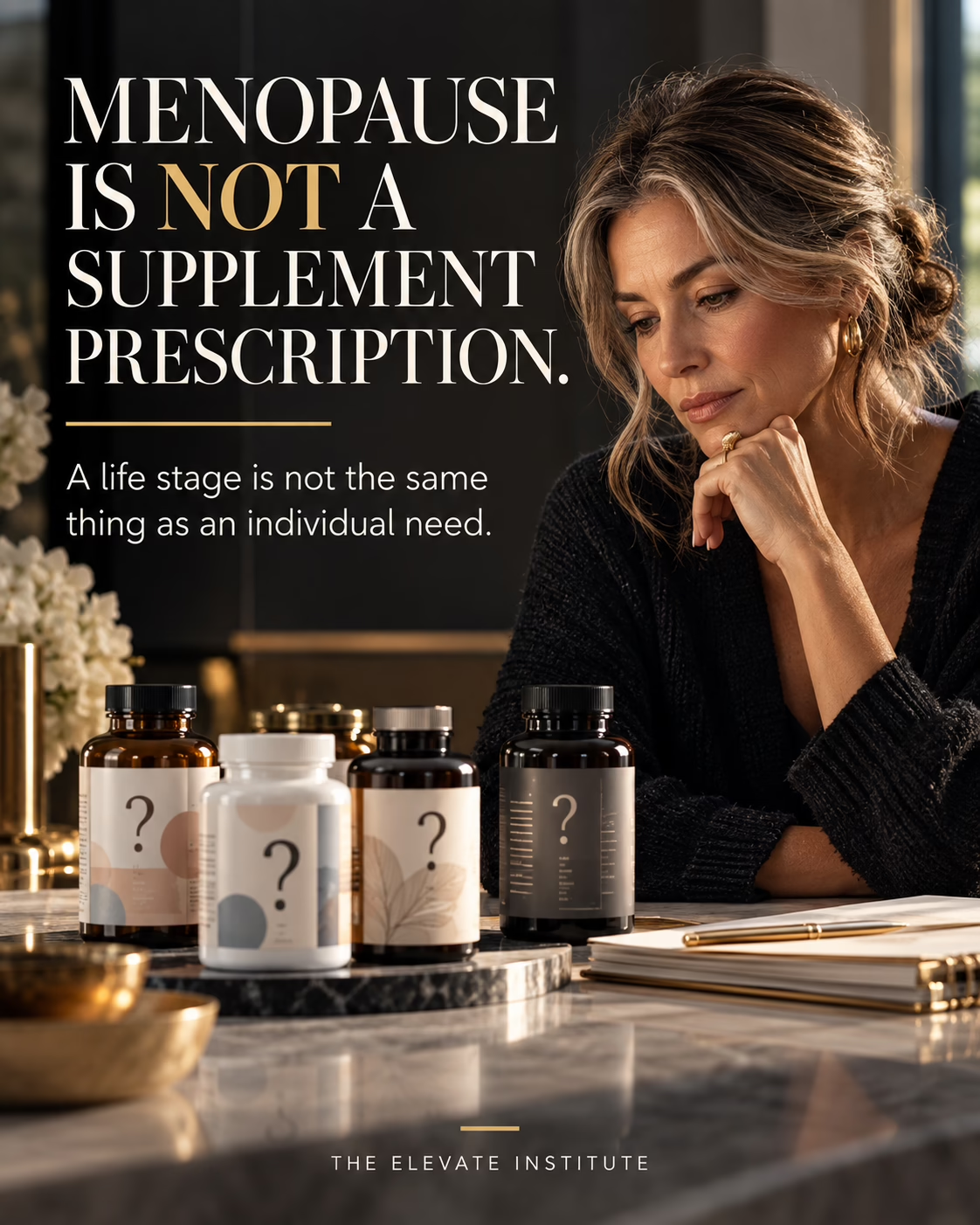
It is not a supplement prescription.
References & Documents Cited
Which?. Best menopause supplements: reviewed by nutrition experts. Updated September 25, 2026. Which? evaluated 26 menopause supplements and more than 78 active ingredients. Which? menopause supplement investigation
Bawden A. Menopause supplements costing more than £400 a year ‘no better than cheap multivitamin’. The Guardian. September 30, 2026. The Guardian report on the Which? findings
U.S. Food and Drug Administration. Information for Consumers on Using Dietary Supplements. FDA explains that dietary supplements are not approved for safety and effectiveness before marketing. FDA consumer supplement guidance
U.S. Food and Drug Administration. FDA 101: Dietary Supplements. Includes regulation, interactions and consumer-safety guidance. FDA dietary supplement overview
National Center for Complementary and Integrative Health. Black Cohosh: Usefulness and Safety. NCCIH black cohosh evidence review
The Menopause Society. Hot Flashes. Evidence overview of hormonal, nonhormonal and complementary approaches. The Menopause Society hot-flash guidance
LeBlanc ES, et al. Calcium and Vitamin D supplementation do not influence menopause-related symptoms: Results of the Women’s Health Initiative Trial. Women’s Health Initiative study record
National Institutes of Health Office of Dietary Supplements. Iron — Health Professional Fact Sheet. Includes medication-interaction information. NIH iron fact sheet
National Institutes of Health Office of Dietary Supplements. Iodine — Health Professional Fact Sheet. Includes thyroid and medication considerations. NIH iodine fact sheet
FAQ — Do menopause supplements work? Some individual nutrients and botanicals have evidence for specific purposes, while evidence for many marketed menopause ingredients is limited or inconsistent. The effectiveness of a branded combination cannot be inferred simply because it contains a studied ingredient. Which?
FAQ — Does every woman need a menopause multivitamin? No authoritative clinical source establishes that every woman needs a specialized menopause multivitamin. Nutritional needs vary with diet, health history, medications, menstrual status and other factors.
FAQ — Should menopausal women take calcium and vitamin D? Bone health becomes increasingly important around menopause, and adequate calcium and vitamin D matter for skeletal health. That does not make them treatments for hot flashes, sleep or mood symptoms; a large Women’s Health Initiative trial did not find those symptoms improved with calcium plus vitamin D supplementation. PubMed Central (PMC)
FAQ — Are herbal menopause supplements safer because they are natural? Not necessarily. Botanicals can have biological effects, side effects and medication interactions. FDA specifically cautions against assuming “natural” means safe. U.S. Food and Drug Administration
FAQ — What should I do before taking a menopause supplement? Identify the symptom or health goal, review diet and existing supplements, consider medication interactions, and discuss relevant concerns with an appropriate healthcare professional. Persistent or significant symptoms may warrant clinical evaluation before supplementation.
Discover more from The Elevate Institute
Subscribe to get the latest posts sent to your email.