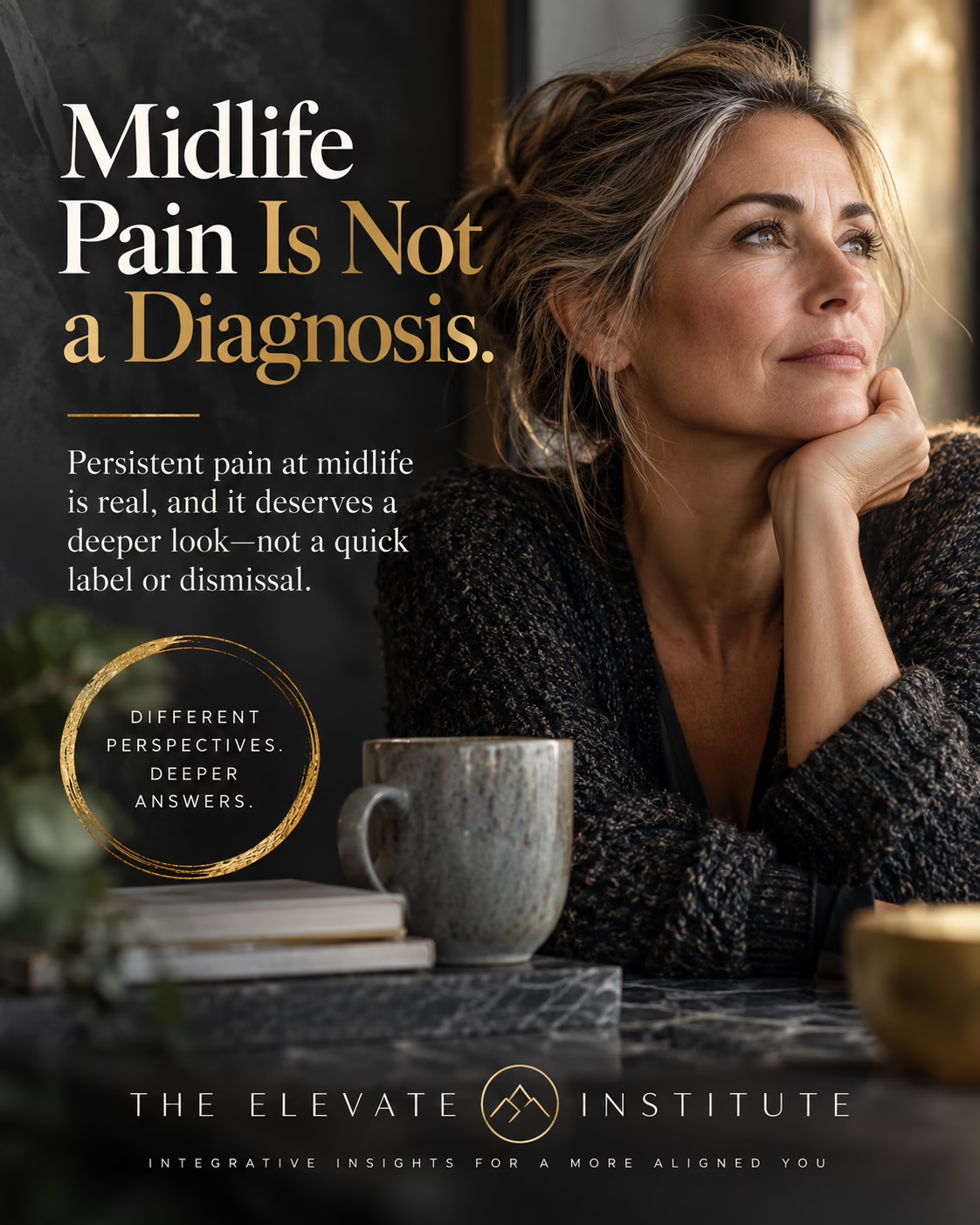


Menopause Joint Pain: Why Midlife Aches Need Better Questions
You used to finish a demanding day, sleep, and feel ready for another.
Now you wake with stiff fingers, sore hips, or a shoulder that seems to
complain about everything. Recovery takes longer than it used to. Maybe
you have already changed your workouts, bought a supplement marketed to
women over forty, or wondered whether the problem is simply another
unwelcome gift from menopause.
That last possibility deserves attention, but it is not a diagnosis. A
life stage can change the context in which pain develops without
identifying its cause. When we use “menopause” as the explanation for
every new ache, we risk overlooking what the symptom is actually telling
us—and what might need medical attention.
This Sunday, October 18, is World Menopause Day. The International
Menopause
Society
has chosen Chronic Pain at Midlife as its 2026 theme. It is an
unusually important choice because joint and muscle pain are often
discussed as background inconveniences, even when they begin to change
how a woman works, moves, sleeps, and participates in her own life.
The Pain Conversation Has New Evidence Behind It
On October 5, 2026, researchers published a large analysis in Nature
Medicine drawing on self-reported pain information from more than 6.1
million people, across 902 population-based data sources in 118
countries and territories. Women reported pain more frequently than
men at all 11 anatomical sites examined. Across the populations
studied, reported pain prevalence generally rose most sharply before age
55, although the patterns varied by body area. Read the original
study.
That finding is striking, but it does not prove that menopause caused
the difference. The study was not designed to isolate the menopausal
transition, measure estrogen as the explanation for pain, or follow the
same women through each stage of reproductive aging. Much of the
underlying information was collected at a single point in time. It tells
us something important about the scale and distribution of pain, not why
a particular woman has aching knees.
A second publication offers a more directly relevant perspective. The
International Menopause Society’s 2026 white paper, Chronic Pain at
Midlife, was published
online on September 9. Its authors review the interplay of reproductive
hormonal changes, musculoskeletal health, nervous-system processing,
sleep, mood, social conditions, and existing pain disorders. This is an
expert synthesis of available evidence, not a new clinical trial. Its
central message is that chronic pain at midlife deserves individualized,
multidisciplinary attention rather than automatic dismissal.
Hormones Matter. They Do Not Explain Everything.
The menopausal transition can involve changing estrogen levels, hot
flashes, sleep disruption, changes in body composition, and other
symptoms. The National Institutes of
Health recognizes that
some women notice stiff or aching joints and muscles during this time.
Hormonal changes may influence tissues and pain pathways, but “may
influence” is not the same as “must be the cause.”
A sore joint might reflect osteoarthritis, inflammatory arthritis,
tendon irritation, an injury, a change in activity, or something else.
Pain that appears alongside menopause may be related to the transition,
may be aggravated by its symptoms, or may have developed independently.
Even two women with nearly identical menstrual histories can have
entirely different reasons for hurting.
There is also a useful distinction between joint pain and joint
disease. Pain is an experience and a symptom; arthritis describes a
group of conditions with specific clinical features and possible tissue
changes. The National Institute of Arthritis and Musculoskeletal and
Skin Diseases
explains that redness, heat, swelling, and other findings can help
clinicians identify the kind of joint problem involved. No amount of
symptom-pattern interpretation should replace that assessment when those
signs appear.
Why Sleep and Recovery Belong in the Same Conversation
Imagine a woman whose hip pain worsens just as her sleep becomes
fragmented by night sweats. She may begin moving less because she is
exhausted, lose confidence in her usual exercise routine, and find that
even modest activity leaves her feeling sore. At work, concentration
becomes more difficult. At home, the activities that once replenished
her start to feel like additional obligations.
Which problem came first? The answer matters, but it may not be a simple
one. Pain can disturb sleep, while poor sleep can affect pain
sensitivity, energy, and the ability to cope with discomfort. The
National Institute on
Aging
describes how sleep difficulties during the menopausal transition can
influence memory, mood, and daily function. The 2026 menopause white
paper likewise treats sleep disturbance and fatigue as part of the wider
pain picture.
This is where the conventional habit of separating symptoms into
individual boxes can become frustrating. The hip belongs to one
appointment, the night sweats to another, the fatigue to a third, and
the work stress to a conversation that may never happen at all. Each
specialist can have a valid piece of information while the woman herself
is left carrying the entire puzzle.
A Hormone Prescription Is Not a Universal Pain Solution
Because hormones can influence musculoskeletal tissues, it is reasonable
to ask whether menopausal hormone therapy improves pain. The evidence is
not nearly as straightforward as the marketing conversation sometimes
suggests. A systematic review and meta-analysis published in Post
Reproductive Health
examined 57 studies involving nearly four million participants and found
no significant overall association between ever using hormone therapy
and generalized musculoskeletal pain in its principal pooled comparison.
Results varied across conditions and study designs, limiting firm
conclusions.
That does not mean hormone therapy has no legitimate place in menopause
care. It means a woman with persistent joint pain should not assume that
estrogen is the missing answer or that one treatment is appropriate for
everyone. Decisions about hormone therapy belong with qualified
clinicians who can weigh the particular symptoms, medical history,
benefits, risks, and alternatives.
The same standard should apply to supplements. Magnesium, calcium,
vitamin D, and other nutrients have real physiological functions, but a
symptom is not a dosage instruction. Pain alone does not tell us whether
a nutrient is low, whether supplementation is appropriate, or whether
another condition is being missed. Buying a product for “menopause
joints” can feel like taking action while leaving the underlying
question unanswered.
The Pattern Is More Useful Than the Label
At The Elevate Institute, I work from a different starting point: What
is connected, what has changed, what is compensating, and what has been
overlooked because the pieces were examined separately? That does not
mean every symptom has one hidden root cause. It means that a person’s
health deserves more thoughtful interpretation than a collection of
isolated complaints.
For a woman experiencing new pain at midlife, I would want to know when
it began, which joints are involved, whether there is swelling, how long
morning stiffness lasts, what has changed in her sleep and activity, and
how the discomfort affects her actual life. I would also want to know
whether she has already received a medical evaluation. Those details
help distinguish a situation requiring clinical investigation from the
broader questions of nutrition, recovery, and daily support.
True Holistic Healing does not require us to pretend that medicine,
mineral balancing, emotional demands, environmental circumstances, and
personal agency are unrelated. They are already interacting in the same
person. But it also requires us to respect the limits of each method. A
medical examination can identify conditions that a hair mineral test
cannot. A mineral-pattern assessment may inform personalized nutritional
discussions, but it cannot diagnose arthritis, explain chronic pain on
its own, or replace appropriate clinical tests.
This distinction is especially important for capable, high-achieving
women. You may be excellent at gathering information, implementing a
plan, and expecting a result. The body, however, is not a
project-management dashboard. Better information helps us make better
decisions, but it does not guarantee that every symptom follows our
preferred timetable.
What to Bring Into Your Next Health Conversation
If you have persistent or worsening joint pain, begin with a qualified
medical evaluation. Keep a short record of where the pain occurs,
whether it is symmetrical, when it is worst, whether there is swelling
or warmth, and how it affects sleep and daily movement. Include recent
injuries, new medications, supplements, menstrual changes, and any
symptoms such as unusual fatigue or fever. The pattern you describe may
help a clinician decide whether examination, laboratory testing,
imaging, or a specialist referral is appropriate.
Seek urgent medical care for a suddenly red, hot, swollen
joint—particularly with fever—or for severe new pain after an
injury. Do not assume these are ordinary menopause symptoms. Conditions
such as inflammatory arthritis and joint infection require timely
assessment, and delaying evaluation can matter.
Once the medical questions are being addressed, you can also ask a
different kind of question about your nutritional choices. Are you
taking supplements because someone told you women your age need them, or
because you have gathered information relevant to your own situation?
Are you adjusting your routine based on evidence, or adding one more
product every time a new symptom appears?
That is where REVEAL can offer a separate, personalized
conversation. Through hair tissue mineral analysis and practitioner
interpretation, we explore mineral patterns as one part of a broader
nutritional picture. REVEAL is not a treatment for joint pain or
menopause, and it is not a substitute for medical evaluation. Its
purpose here is to help you stop choosing mineral support from
generalizations and start asking better-informed questions about your
own pattern.
Don’t let “it’s just menopause” become the end of your investigation.
Get persistent pain properly evaluated—and if you’re ready to stop
guessing about your mineral support, get your personalized insights
with REVEAL
here.
The point of World Menopause Day is not to give every woman another
label. It is to make room for better recognition, better questions, and
care that takes her full experience seriously. Pain may be part of a
transition, but it should never become the price of being told that the
transition is normal.
References & Documents Cited
Fillingim M, Tanguay-Sabourin C, Neuert L, et al. Global and regional
reference curves for pain across the lifespan in 6.1 million individuals
in 118 countries. Nature Medicine. Published October 5, 2026. DOI:
10.1038/s41591-026-04696-w.
Mailis A, Ang SB, Di Renna T, et al. Chronic pain at midlife.
Climacteric. Published online September 9, 2026. DOI:
10.1080/13697137.2026.2722558.
Overton R, Amini P, Chew A, et al. The effect of hormone replacement
therapy on musculoskeletal pain in menopausal women: A systematic review
and meta-analysis. Post Reproductive Health. 2026;32(1):52–68. DOI:
10.1177/20533691251403087.
International Menopause Society. World Menopause Day 2026: Chronic Pain
at Midlife. Official
campaign.
National Institutes of Health. Menopause. Women’s Health
overview.
National Institute on Aging. Sleep Problems and Menopause: What Can I
Do? Clinical
information.
National Institute of Arthritis and Musculoskeletal and Skin Diseases.
Arthritis: Overview and Types. Clinical
information.
Discover more from The Elevate Institute
Subscribe to get the latest posts sent to your email.