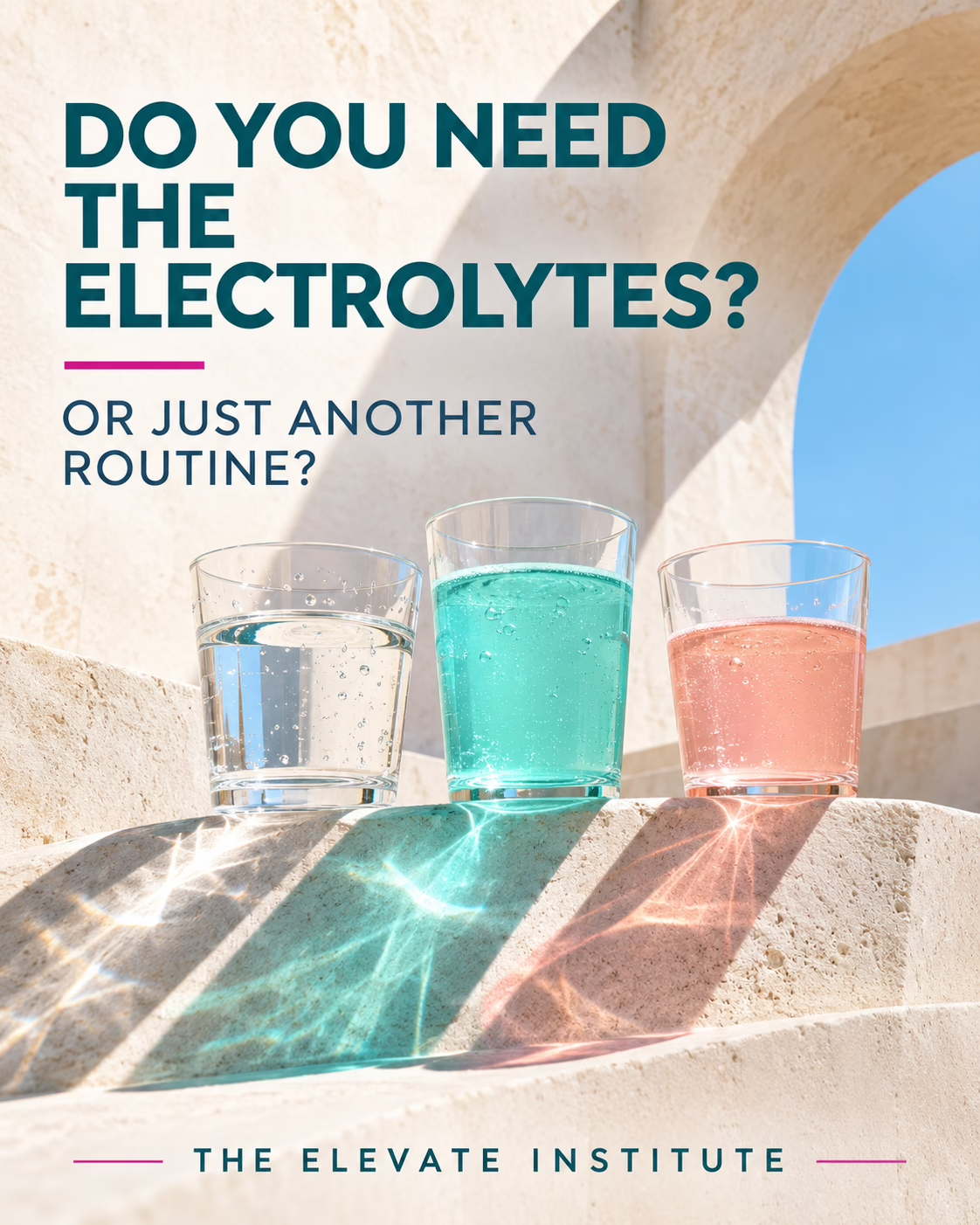



Electrolyte Drinks: Do You Actually Need Them?
By Eva Vennari | The Elevate Institute
There is a new ritual appearing on desks, in gym bags, and beside morning coffee. Someone tears open a little packet of powder, pours it into a glass of water, and announces that they’re taking care of their electrolytes. The colors are attractive, the flavors are increasingly inventive, and the marketing suggests that plain water is somehow an unfinished product. Sometimes the person has just completed a strenuous workout. Sometimes they’ve done little more physically demanding than answer their emails.
The distinction matters more than the packaging would have us believe. Electrolytes are essential to life, and fluid replacement can be important during prolonged exercise, heavy sweating, illness, and other circumstances. But the existence of a biological requirement is not proof that adding a particular product to your daily routine improves your health. A study appearing in the November 2026 issue of a sports-nutrition journal gives us an opportunity to examine what these beverages actually accomplish, and what we are still assuming.
What the new 2026 electrolyte study actually found
Researchers led by Joseph A. Killick compared three hydration strategies during and after exercise in a hot environment: ordinary water, a sodium-potassium beverage, and coconut water, which is relatively rich in potassium. Twelve participants, seven of them men, completed a randomized, triple-blind crossover trial. Each person exercised on a stationary bicycle for sixty minutes in conditions of approximately 33°C, or 91°F, and consumed assigned beverages before and after exercise.
The researchers measured several outcomes, including body mass, body-water percentage, heart rate, thermal discomfort, fatigue, handgrip strength, jumping performance, and white blood cell count. The heat exercise produced clear physiological changes across the participants. But the investigators did not find statistically significant differences between the three hydration strategies on the outcomes measured. The paper was published online August 13 and appeared in print on November 1, 2026. Read the original study.
That result is interesting precisely because the beverages were not identical. They provided different electrolyte compositions, yet those differences did not translate into detectable advantages under this particular protocol. It is tempting to announce that expensive electrolyte drinks are pointless. That would be an overstatement. Twelve participants cannot settle the broader science of hydration, and a sixty-minute cycling experiment cannot represent endurance races, physically demanding occupations, or every person’s sweat losses.
A study that fails to demonstrate a difference is not automatically proof that no difference exists. What it can do is challenge the confidence with which we assume one formula must outperform another simply because it contains more minerals.
The body needs electrolytes. That doesn’t mean every drink needs them.
Sodium, potassium, chloride, calcium, magnesium, and other electrolytes participate in essential physiological processes. They help regulate fluid balance, nerve signaling, muscle function, and normal electrical activity in the heart. Sodium is especially important in extracellular fluid regulation, while potassium is the major positively charged ion inside cells. Their concentrations are controlled through complex interactions involving the kidneys, hormones, and movement of substances between body compartments.
These are not decorative nutrients. But neither are they ingredients that can be added without context. The National Library of Medicine’s electrolyte panel guidance explains that blood testing is used to assess clinically relevant electrolyte concentrations and that abnormal results can be associated with dehydration, kidney disease, medications, and other medical conditions. Symptoms such as fatigue, muscle weakness, cramps, confusion, or an irregular heartbeat may warrant evaluation, but none of those symptoms identifies a particular mineral deficiency by itself.
This is where consumer language begins to blur several different questions. Are you losing significant fluid? Are you losing electrolytes along with that fluid? Is your regular diet meeting your nutritional needs? Is there a medical condition affecting electrolyte regulation? And does a particular beverage provide an appropriate amount of the substances you actually need?
Those questions overlap, but they are not interchangeable. A person who is thirsty after a warm afternoon may need a drink. Someone who has spent hours sweating heavily may have additional replacement needs. Someone with persistent muscle weakness or palpitations may need medical assessment rather than a new powder. Calling all three situations “needing electrolytes” conceals the very distinctions that make good decisions possible.
When adding electrolytes can make sense
Exercise science has never argued that water is the only appropriate fluid under every circumstance. The American College of Sports Medicine’s guidance on exercise and fluid replacement recognizes that electrolyte-containing beverages can be useful during prolonged or demanding exercise, particularly when fluid and sodium losses are substantial. Sweat rates and electrolyte losses vary between individuals, so the appropriate strategy depends on the conditions and the person rather than a single universal formula. ACSM position stand.
A second small study published in the April 2026 issue of Journal of Strength and Conditioning Research compared flavored water, coconut water, and a carbohydrate-electrolyte sports beverage after exercise-induced dehydration. Eight recreational athletes completed the crossover experiment. Coconut water and the sports beverage were associated with less urine output during rehydration than flavored water, but final hydration status did not differ significantly between the beverages. That study did not prove the drinks were identical either; it demonstrated how different outcomes can tell somewhat different stories. Read the original trial.
Together, these studies suggest that the details of fluid replacement matter, but they do not justify a universal electrolyte prescription. The conditions under which a beverage is tested are part of the evidence. A result from athletes exercising in heat cannot be casually transferred to a person sitting in an air-conditioned office who simply wants more energy.
Illness creates another distinct situation. Vomiting and diarrhea can produce clinically important fluid and electrolyte losses. The National Institute of Diabetes and Digestive and Kidney Diseases describes oral rehydration solutions as one option for replacing these losses, with additional medical guidance for people with significant dehydration or underlying conditions. A sports drink, an everyday flavored electrolyte powder, and a medically formulated oral rehydration solution should not be treated as interchangeable products.
More sodium and potassium are not automatically better
The mineral story becomes particularly important when people begin using these products every day without considering what they already consume. According to the CDC’s June 29, 2026 sodium guidance, American adults consume more than 3,300 milligrams of sodium daily on average, above the federal recommendation of less than 2,300 milligrams for most teens and adults. Excess sodium intake can contribute to elevated blood pressure and cardiovascular risk. A person with substantial sweat losses may have different short-term replacement considerations, but that does not make added sodium an automatic daily benefit. CDC sodium guidance.
Potassium requires a different sort of caution. Many people consume less potassium than recommended through their diets, and potassium-rich foods are important components of healthy eating. But the NIH Office of Dietary Supplements explains that impaired kidney function and certain medications can increase the risk of dangerously elevated blood potassium. ACE inhibitors, angiotensin receptor blockers, and potassium-sparing diuretics are particularly relevant examples. Excess potassium can affect cardiac rhythm, sometimes seriously.
This is why I resist treating a long ingredient list as evidence of sophistication. The presence of magnesium, sodium, potassium, and additional vitamins may make a drink look comprehensive. It does not tell us whether the amounts are suitable for the person consuming it. It also does not tell us whether fatigue, headaches, cramps, or poor recovery have anything to do with electrolyte intake in the first place.
For anyone taking medication, managing kidney or cardiovascular disease, or following fluid or mineral restrictions, a clinician or pharmacist should review supplement ingredients before they become a routine. And if someone develops severe weakness, confusion, fainting, chest symptoms, or a concerning irregular heartbeat, that calls for prompt medical evaluation, not a do-it-yourself hydration experiment.
The difference between replacing a loss and creating a ritual
Here is the True Holistic Healing question I find more useful than debating which powder tastes best: What problem are you actually trying to solve?
If you’ve been sweating heavily during a long workout, fluid replacement is a reasonable subject to investigate. If you are exhausted after weeks of poor sleep, irregular meals, emotional pressure, and relentless demands, an electrolyte drink may be addressing a very small part of a much larger situation—or none of it. If you’re frequently experiencing cramps, headaches, or unusual fatigue, the responsible question is whether a medical cause needs to be investigated, not which mineral sounds most plausible on social media.
A replacement strategy begins with understanding what was lost. A wellness ritual often begins with buying what someone suggested. That distinction is my TEI interpretation, not a conclusion tested by the hydration trials. It reflects a broader principle: physical needs, work demands, habits, environment, recovery, and emotional pressures are already interacting in daily life. They cannot be understood fully by examining a single product in isolation.
This does not mean every useful habit needs laboratory testing. Ordinary drinking, eating, and physical activity are part of everyday self-care. But when a person begins stacking products to correct an assumed deficiency, or repeatedly changes supplements because symptoms persist, the stakes change. It becomes important to separate a useful routine from a treatment decision and to distinguish nutritional questions from medical diagnoses.
Where individualized mineral assessment belongs—and where it doesn’t
At The Elevate Institute, REVEAL is the standalone mineral-balancing experience built around hair tissue mineral analysis, practitioner interpretation, and personalized recommendations. It is intended to help people examine a broader mineral-balancing picture rather than repeatedly choosing supplements based on advertisements or generic wellness trends.
That scope needs to be understood accurately. Hair tissue mineral analysis is not the clinical test used to diagnose dehydration, low blood sodium, or high blood potassium. A suspected electrolyte disorder requires appropriate medical evaluation and, when indicated, blood testing. REVEAL should not be presented as a substitute for those investigations, nor does the exercise-hydration research establish that REVEAL improves athletic rehydration or prevents electrolyte complications.
The legitimate connection is narrower and more useful. If your concern extends beyond which beverage to choose—if you’re accumulating supplements without a coherent understanding of your mineral-balancing approach—REVEAL offers a structured, individualized starting point within TEI’s established practice. That is different from promising that a hair test can determine the ideal sodium concentration for your next marathon.
What to do before opening another packet
Start with the circumstances rather than the product. Are you replacing meaningful losses from heat, prolonged exercise, or illness? Are you drinking a product because you enjoy it, or because you believe it is treating a problem? What sodium, potassium, sugar, and other ingredients does it actually contain? Does your health history or medication list make any of those ingredients important to discuss with a qualified professional?
For a generally healthy person going through an ordinary day, water and a varied diet will often be sufficient. For someone with substantial exercise-related losses, a more specific hydration strategy may be useful. For persistent symptoms or suspected electrolyte abnormalities, appropriate clinical assessment comes first. None of those decisions requires turning hydration into a contest to see who can consume the most impressive mineral blend.
If you’re ready to examine the larger pattern of your mineral-balancing and supplement choices, explore REVEAL through The Elevate Institute’s established intake pathway. The aim is not to sell you another ingredient to add to your water. It’s to replace indiscriminate guessing with a more deliberate, individualized conversation about your health.
The next time someone tells you that plain water is no longer enough, ask the question that should have come before the recommendation: Enough for what? The answer should begin with the actual circumstances of your life, not the contents of a packet.
References & Documents Cited
-
Killick JA, Jenkins EJ, Benson J, Macciochi J, Corr L. Comparing the Effects of Water, Sodium-Potassium, and Potassium-Rich Solutions on Fluid Balance and Thermal Strain Following Exercise in the Heat: A Randomized Triple-Blind Crossover Study. International Journal of Sport Nutrition and Exercise Metabolism. 2026;36(6):622–630. Published online August 13; print November 1. DOI: 10.1123/ijsnem.2026-0016.
-
Bell SK, Spriet LL. Rehydration After Exercise-Induced Fluid Losses: Comparing Flavored Water, Coconut Water, and Carbohydrate-Electrolyte Sports Beverage. Journal of Strength and Conditioning Research. 2026;40(4):431–438. DOI: 10.1519/JSC.0000000000005322.
-
Sawka MN, Burke LM, Eichner ER, Maughan RJ, Montain SJ, Stachenfeld NS. American College of Sports Medicine Position Stand: Exercise and Fluid Replacement. Medicine & Science in Sports & Exercise. 2007;39(2):377–390. PubMed.
-
Centers for Disease Control and Prevention. About Sodium and Health. Updated June 29, 2026. Official guidance.
-
National Institutes of Health, Office of Dietary Supplements. Potassium: Fact Sheet for Health Professionals. Official reference.
-
National Library of Medicine, MedlinePlus. Electrolyte Panel. Official medical testing reference.
-
National Institute of Diabetes and Digestive and Kidney Diseases. Treatment of Diarrhea. Official clinical guidance.
Question Answer Are electrolyte drinks better than water? Not universally. A 2026 trial involving 12 participants found no statistically significant differences among the tested strategies, but the study was small. PubMedWhen might I need additional electrolytes? Prolonged exercise, substantial sweating, and certain illnesses can increase replacement needs. The appropriate strategy depends on the circumstances. PubMed+1Can too much potassium be harmful? Yes, particularly with impaired kidney function or medications that reduce potassium excretion. Health Professional Fact SheetCan muscle cramps prove an electrolyte deficiency? No. Cramps can have multiple causes; a clinician may order blood testing when an electrolyte imbalance is suspected. medlineplus.govDoes hair mineral analysis diagnose blood electrolyte imbalance? No. Clinical electrolyte panels measure blood concentrations and are used to evaluate suspected abnormalities. medlineplus.gov
Discover more from The Elevate Institute
Subscribe to get the latest posts sent to your email.