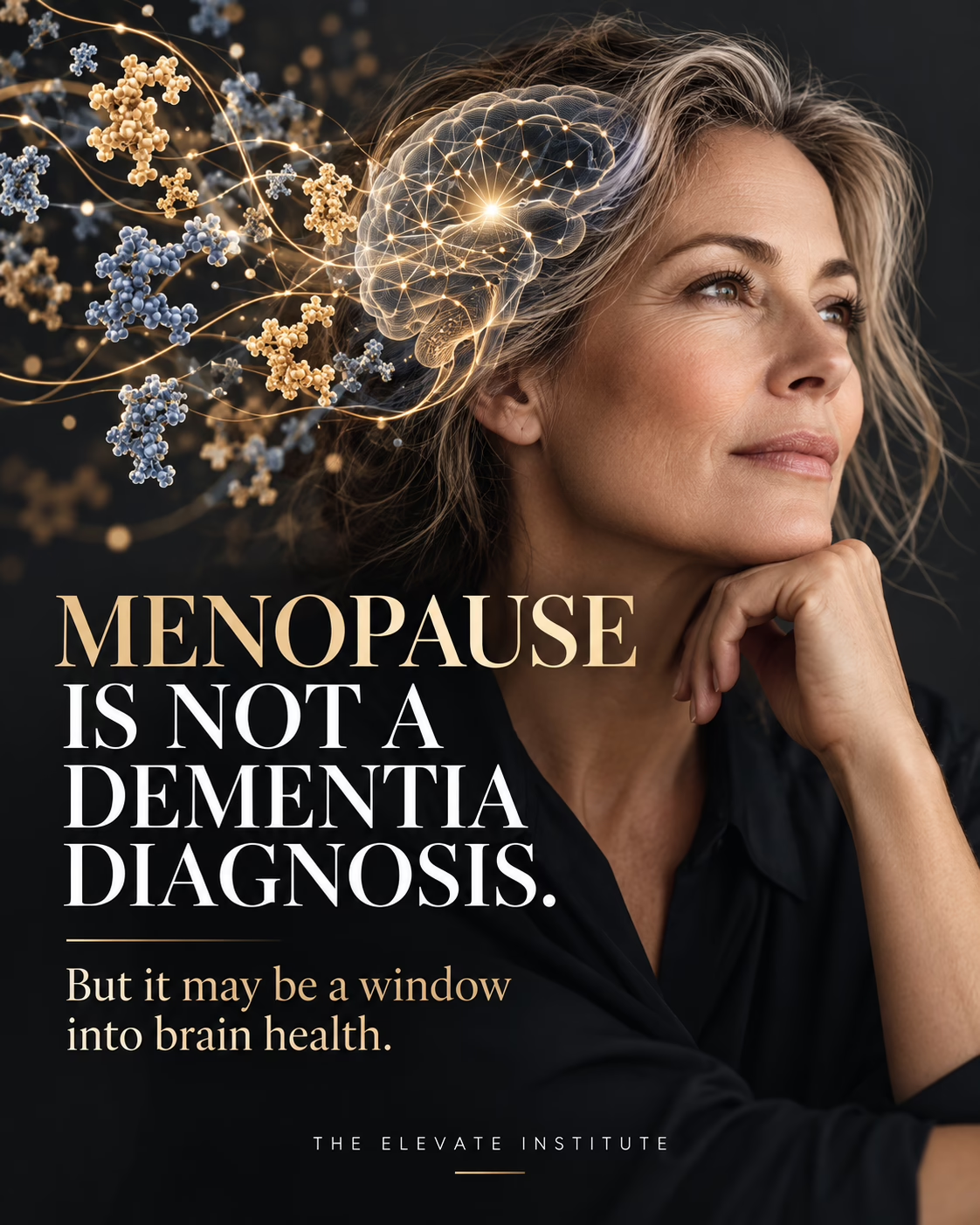



Menopause Is Not a Dementia Diagnosis. But It May Be a Window Into Brain Health.
There is a peculiar moment in midlife when a woman can walk into a room, forget why she is there, lose a perfectly ordinary noun halfway through a sentence and wonder whether her brain has quietly resigned without giving notice.
Then the internet arrives to help.
Depending on what she reads first, she may be told that brain fog is simply menopause and therefore nothing to worry about—or that menopause is setting her up for Alzheimer’s disease.
Neither interpretation does justice to what the science is actually telling us.
A new study published September 22 in Nature Medicine gives us something much more interesting than another reason to panic about aging. Researchers found measurable changes in blood proteins across the menopause transition involving inflammatory, metabolic, synaptic and Alzheimer’s-related biological pathways. In several cohorts of older women, patterns involving those proteins were also associated with cognitive aging and dementia risk. Nature
That sounds ominous until we read the study rather than the headline.
The researchers are quite clear: most women who go through menopause do not develop dementia. Menopause may instead represent a biological window during which researchers can better understand why some women later experience cognitive decline while others remain remarkably resilient. Nature
That distinction matters.
Menopause Changes the Context, Not Just the Hormones
In the initial portion of the study, researchers examined 80 women ages 43 to 58 who had been carefully classified as premenopausal, perimenopausal or postmenopausal. They measured a large array of circulating proteins and found changes involving immune and inflammatory signaling, synaptic biology, metabolism and biological processes associated with Alzheimer’s disease.
Interestingly, those patterns tracked more strongly with hormonal measures than with age alone. The researchers then tested aspects of the findings in larger independent cohorts, including thousands of women, and found broader menopause-associated biological changes. In four cohorts of older women totaling 11,925 participants, higher menopause-related proteomic scores were consistently associated with cognitive aging and dementia risk. Nature
This does not mean researchers have discovered a menopause blood test for Alzheimer’s disease.
It does not mean a woman experiencing word-finding difficulty at 51 is developing dementia.
And it certainly does not mean menopause itself is a disease.
What it does suggest is that the transition is biologically consequential. Hormonal change occurs within a much larger physiological landscape, and the brain is part of that landscape.
That should sound obvious. Yet health care—and wellness culture—still has a habit of taking one recognizable transition and allowing it to swallow every symptom occurring near it.
“It’s Menopause” Is Sometimes an Answer. Sometimes It Ends the Investigation Too Soon.
Brain fog, difficulty concentrating, sleep disturbance and mood changes are commonly reported during the menopause transition. But the existence of a common explanation does not make every individual case identical.
Consider what else can affect how clearly a person thinks.
Sleep matters. Blood pressure matters. Depression can affect concentration and memory. Medications can affect cognition. Diabetes and vascular health matter. Nutritional status matters. Alcohol can matter. Neurological disease matters. The National Institute on Aging specifically notes that cognitive problems can have multiple causes and that conditions including diabetes, depression and stroke can affect cognitive health. National Institute on Aging
This is where I think we make a conceptual mistake.
We ask:
What causes menopause brain fog?
But that question assumes there is one thing called “menopause brain fog” with one mechanism waiting to be discovered.
A more useful question is:
What is influencing this woman’s cognitive function while she is moving through menopause?
Those are not the same question.
The first searches for a universal explanation.
The second investigates a person.
A Life Stage Is Context, Not a Complete Case History
This is one of the reasons I am wary whenever a life stage becomes an automatic treatment protocol.
You are menopausal, therefore take this supplement.
You are tired, therefore support your adrenals.
You cannot concentrate, therefore take something for your brain.
You are gaining weight, therefore fix your hormones.
It is wonderfully tidy. Human physiology rarely cooperates.
A woman does not cease to have a cardiovascular system, digestive system, mineral economy, nervous system, relationships, sleep patterns, environmental exposures, emotional history and individual genetics simply because her estrogen changes.
Menopause happens inside an already-existing human being.
That is the distinction I want women to hear in this research.
The new study is fascinating precisely because it does not reduce menopause to estrogen. The researchers found shifts across inflammatory, synaptic and metabolic processes as well as proteins associated with Alzheimer’s biology. Nature
In other words, even at the molecular level, the story is not one-dimensional.
Brain Fog Is Not a Dementia Diagnosis
There is also an important boundary between taking cognitive symptoms seriously and frightening women unnecessarily.
Forgetting a word occasionally is not the same thing as losing the ability to function independently.
Mild cognitive impairment itself occupies a distinct clinical territory. The National Institute on Aging describes it as more memory or thinking difficulty than would normally be expected for age while a person can still perform normal daily activities. Some people with mild cognitive impairment later develop dementia; others do not. National Institute on Aging
Persistent changes deserve evaluation, particularly when they are worsening, interfering with daily function, appearing suddenly or accompanied by other neurological symptoms.
But “pay attention” and “panic” are not synonyms.
The responsible interpretation of this new menopause research is not that millions of women should begin watching themselves for Alzheimer’s disease every time they misplace their keys.
It is that midlife deserves to be taken seriously as a period of health assessment.
Midlife May Be a Window of Opportunity
One of the most useful ideas in this research is the concept of a window.
A window is not a verdict.
It is a place from which we can see more clearly.
If menopause-associated biology eventually helps researchers identify women at higher risk of cognitive decline earlier, that could open important possibilities for prevention research and individualized care. But the proteins identified in this study are not currently a clinical screening test, and the study does not establish a treatment strategy. Nature
What we already know is that brain health is connected to health well beyond the brain.
The National Institute on Aging highlights management of high blood pressure, physical activity and management of chronic health conditions among measures associated with protecting cognitive health. Midlife hypertension in particular is associated with later cognitive decline. National Institute on Aging
That should widen the conversation.
A woman worried about her memory may need a cognitive evaluation. She may also need someone to notice that she has been sleeping five hours a night, that her blood pressure has crept upward, that a medication changed six months ago, that she is experiencing depression, or that another health problem has gone unrecognized.
The point is not to decide in advance which one matters.
The point is to investigate.
Personalized Does Not Mean More Supplements
This is also where “personalized wellness” can become a rather expensive euphemism for guessing.
Buying a supplement marketed for menopause is not personalization.
Taking a handful of products because several symptoms appeared at the same time is not investigation.
Personalization begins with information.
At The Elevate Institute, that principle is central to REVEAL. We use mineral-pattern information as one part of understanding an individual’s physiological landscape rather than assuming that every person who shares a symptom—or a life stage—shares the same needs.
REVEAL is not a dementia assessment and does not replace medical evaluation for cognitive symptoms. If memory or thinking changes are persistent, progressive or concerning, appropriate medical evaluation belongs in the picture.
But if you have reached the point where you are collecting generalized advice for menopause and wondering which recommendation actually applies to you, that is a different question.
And it is a much better one.
Because menopause may indeed be a window into brain health.
The useful response is not to stare through that window in fear.
It is to look at what is actually there.
For a Look at The Elevate Institute’s REVEAL program that was suggested with this article, read more…
References & Documents Cited
Wood Alexander M, Rabin JS, Caunca M, et al. Blood proteomics of menopause map to brain aging and dementia risk. Nature Medicine. Published September 22, 2026. DOI: 10.1038/s41591-026-04648-4. Nature
Read the Nature Medicine study
National Institute on Aging. What Is Mild Cognitive Impairment? National Institute on Aging
NIA guide to mild cognitive impairment
National Institute on Aging. Cognitive Health and Older Adults. National Institute on Aging
NIA cognitive-health guidance
National Institute on Aging. Memory Problems, Forgetfulness, and Aging. National Institute on Aging
NIA guidance on memory changes
FAQ: Does menopause cause dementia? No. The new study found biological associations; it did not establish that menopause causes dementia, and the researchers emphasize that most women who undergo menopause do not develop dementia. Nature
Is menopause brain fog the same as mild cognitive impairment? No. Mild cognitive impairment is a clinical condition involving greater thinking or memory difficulty than expected for age while normal daily independence is largely maintained. National Institute on Aging
Should memory changes during menopause be evaluated? Persistent, progressive or concerning cognitive changes should be discussed with a qualified clinician because many conditions can affect cognition. National Institute on Aging
Can supplements prevent dementia? No supplement has been established as a general dementia-prevention strategy. NIA cautions against unproven products claiming to sharpen memory or prevent brain disorders.
Discover more from The Elevate Institute
Subscribe to get the latest posts sent to your email.