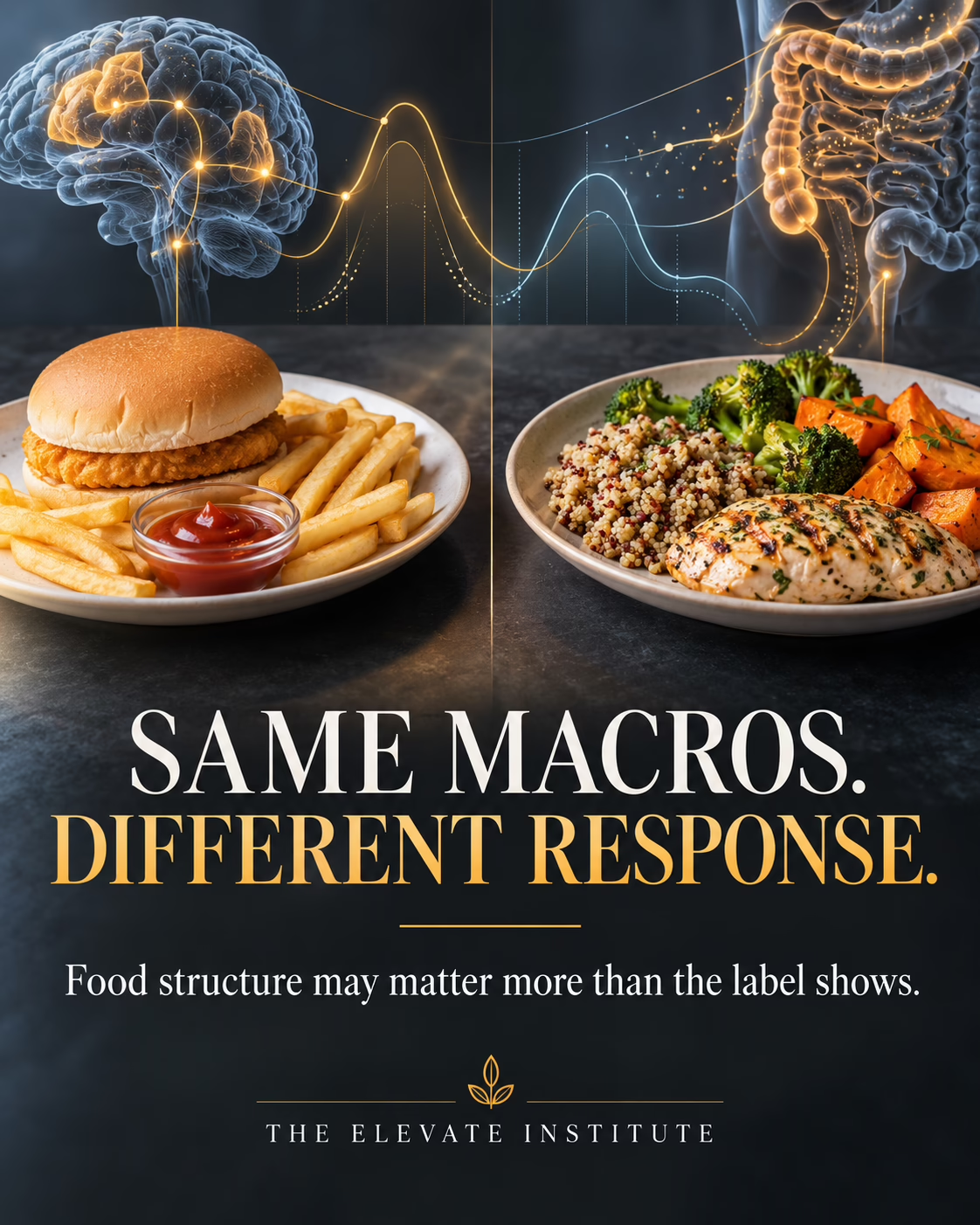



Same Calories. Same Macros. Your Body May Still Know the Difference.
We have become very good at reducing food to arithmetic.
Calories.
Protein.
Carbohydrates.
Fat.
Fiber.
Sugar.
Sodium.
Put those numbers into an app, hit the targets, and we have supposedly answered the nutritional question.
Except a fascinating new experiment suggests the human body may be considerably less impressed by our spreadsheet.
Researchers publishing this week in Nature Metabolism gave healthy adults two meals that were remarkably similar nutritionally. The meals were closely matched for calories, energy density, macronutrients, available carbohydrate, glycemic index and load, fiber, sodium and even water.
One was ultra-processed.
The other was not.
The participants’ bodies responded differently anyway. Nature
That does not mean calories suddenly stopped mattering.
It means food may be more than the sum of the numbers printed on its label.
And that is a much more interesting nutritional conversation.
A Clever Experiment Asked a Better Question
Much of the research linking ultra-processed foods with poor health is observational.
People who consume more ultra-processed food may also differ in income, physical activity, smoking, overall dietary quality and dozens of other ways. Researchers can statistically adjust for many of those differences, but observational research always leaves the difficult question:
Is the ultra-processed food contributing to the outcome, or is it traveling alongside something else that is?
The new study took a different approach.
Researchers recruited 57 healthy-weight adults for a randomized crossover experiment. Thirty-two completed both metabolic meal sessions, allowing each person to serve, essentially, as his or her own comparison.
Participants ate approximately 300-calorie meals that were either entirely ultra-processed or non-ultra-processed. The researchers had gone to considerable trouble to match the meals nutritionally. Energy, energy density, macronutrients, available carbohydrate, glycemic index and load, fiber, sodium and water differed by no more than 1.6%. Nature
Then they watched what happened for three hours.
That is where the neat little nutrition-label story became considerably messier.
Same Nutrients Did Not Produce the Same Response
Overall glucose exposure did not differ significantly between meals.
Insulin did.
The ultra-processed meal produced a greater insulin response over the post-meal period. Researchers also observed differences in metabolic rate and in how carbohydrate and fat were being oxidized after eating. Nature
The study also incorporated brain imaging.
Researchers found relationships between metabolic responses and activity in the striatum, an area involved in reward and food valuation. The neural patterns associated with food valuation also differed between conditions even though participants did not report significant differences in how much they liked or wanted the meals immediately after eating them. Nature
That deserves a moment.
Consciously, the participants did not say one meal was dramatically more desirable.
Underneath that conscious rating, their metabolic and neural responses were not identical.
This is not proof that ultra-processed food “hijacks your brain.”
Please do not give the internet ideas.
It is evidence that processing may alter how nutritionally similar food is handled after it enters the body.
Why Might Processing Matter?
“Processing” is an enormous category.
Cooking is processing.
Grinding is processing.
Fermentation is processing.
Freezing vegetables is processing.
So the question is not whether humans should eat only things we can pull from the ground with dirt still attached.
Ultra-processing refers to something more specific. Under the NOVA classification used in this study, ultra-processed foods are industrial formulations that generally undergo multiple physical or chemical transformations and often contain ingredients or additives not commonly used in home cooking. Nature
Processing can change food structure.
Heat, extrusion, milling and disruption of plant cell walls can alter how readily nutrients become accessible during digestion. The researchers note, for example, that instant oats can produce a different glycemic response from steel-cut oats despite both being oats, and that disrupting chickpea cell walls can change the amount and speed of carbohydrate reaching the intestine. Nature
That gives us an important distinction:
What a food contains and how readily the body can access what it contains are not necessarily the same thing.
The label tells you the inventory.
It does not give you a complete description of the delivery system.
This Is Not an Argument Against Calories
Nutrition conversations have an unfortunate habit of swinging between religions.
For years:
“Calories are all that matter.”
Then:
“Calories don’t matter at all.”
Neither is particularly useful.
Energy balance remains real.
In a landmark NIH inpatient randomized trial published in 2019, 20 adults spent two weeks eating an ultra-processed diet and two weeks eating an unprocessed diet in random order. They were allowed to eat as much as they wanted.
On the ultra-processed diet, participants consumed about 508 additional calories per day and gained about 0.9 kilograms. During the unprocessed diet, they lost approximately the same amount. PubMed
Calories mattered enormously.
The interesting question was why people spontaneously consumed more of them.
The new Nature Metabolism study moves that question one level deeper. Even when researchers deliberately controlled nutritional composition in a single meal, the body’s immediate response still differed according to how the food had been processed. Nature
Calories matter.
So may the package in which those calories arrive.
Those ideas can coexist without anybody surrendering their nutrition tribe membership card.
The Insulin Result Needs Restraint
I want to be particularly careful here because insulin may be the most abused hormone on social media.
A larger insulin response after an ultra-processed meal does not automatically mean the meal “caused insulin resistance.”
Insulin is supposed to rise after we eat.
It is part of normal physiology.
This study measured an acute post-meal response in healthy adults. It did not demonstrate that the observed insulin difference causes diabetes, obesity or any other chronic disease. Nature
The researchers describe their findings as a possible mechanism deserving further investigation.
That is exactly how we should treat them.
Interesting.
Potentially important.
Not permission to diagnose yourself from a sandwich.
“Ultra-Processed” Is Not Yet a Perfect Consumer Category
There is another wrinkle.
The United States still does not have a single official regulatory definition of ultra-processed food.
The U.S. Food and Drug Administration and United States Department of Agriculture are actively working toward one. The agencies have acknowledged both the growing evidence linking higher consumption of foods commonly considered ultra-processed with chronic disease and the remaining scientific questions about exactly how and why those foods may influence health. U.S. Food and Drug Administration
That uncertainty matters.
A packaged whole-grain bread, flavored yogurt, protein bar, frozen dinner and candy may all land somewhere inside broad processing classifications while having very different nutritional profiles and roles in someone’s diet.
So I would resist replacing calorie counting with NOVA-score counting.
That is still reductionism.
It simply changes spreadsheets.
Your Body Eats the Food. Your App Eats the Numbers.
This is where the new research intersects beautifully with True Holistic Healing.
A nutrition tracker sees:
300 calories.
A certain amount of protein.
A certain amount of carbohydrate.
A certain amount of fat.
Your digestive system encounters something else entirely.
Food structure.
Particle size.
Texture.
Speed of digestion.
Nutrient availability.
Hormonal signals.
Gut-brain communication.
Previous meals.
Your current metabolic state.
And eventually, your behavior around the next meal.
That does not make tracking useless.
It makes tracking incomplete.
We get into trouble when a useful measurement quietly becomes a theory of the whole person.
This happens everywhere in health.
Body weight becomes health.
A blood test becomes health.
Calories become nutrition.
Sleep duration becomes recovery.
One biomarker becomes metabolism.
Useful numbers are still useful.
But a measurement is a window.
It is not the house.
The Better Question Is Not “Is This Food Bad?”
There is no need to become frightened of packaged food.
Convenience matters.
Cost matters.
Time matters.
Accessibility matters.
And a diet that is theoretically pristine but practically impossible to live with is not especially personalized.
The more useful question is what role ultra-processed food occupies in the pattern.
Is it an occasional convenience inside an otherwise varied diet?
Or has it quietly become breakfast, lunch, snacks and dinner?
Are whole-food protein sources disappearing?
Fiber-rich plants?
Foods requiring actual chewing?
Are you hungry again quickly?
Does your energy feel different after particular meals?
Are you trying to manage body composition entirely through calorie arithmetic while ignoring how your food choices affect satiety and eating behavior?
Those questions move us from nutritional morality into observation.
And observation is where personalization begins.
When You Need More Than Another Food Rule
For someone who feels well, eats a varied diet and has no significant health concerns, this study is interesting rather than diagnostic.
For someone dealing with stubborn fatigue, metabolic changes, unpredictable energy, body-composition changes or a long history of trying one nutritional rule after another, it may be time to stop asking the internet for the universally correct diet.
That is one reason REVEAL exists.
REVEAL uses hair mineral analysis to provide individualized information about mineral patterns and physiological context. It does not measure your response to ultra-processed foods, diagnose insulin resistance or tell us whether a particular packaged food is good or bad for you.
What it can do is help move the nutritional conversation from generic guessing toward information about the person actually eating the food.
Because perhaps the most useful lesson from this new experiment is not that processing is dangerous.
It is that composition does not tell the whole physiological story.
Two meals can look remarkably similar on paper.
The body still has to meet them.
And the body, inconveniently and magnificently, does not read nutrition labels.

Your Next step:
References & Documents Cited
Hutelin Z, Ahrens M, Baugh ME, et al. Metabolic and neural responses to ultraprocessed foods: a randomized, controlled, crossover study. Nature Metabolism. Published October 5, 2026. DOI: 10.1038/s42255-026-01619-4. Nature
Read the Nature Metabolism study
Hall KD, Ayuketah A, Brychta R, et al. Ultra-Processed Diets Cause Excess Calorie Intake and Weight Gain: An Inpatient Randomized Controlled Trial of Ad Libitum Food Intake. Cell Metabolism. 2019;30(1):67–77.e3. DOI: 10.1016/j.cmet.2019.05.008. PubMed
Read the PubMed record for the NIH trial
U.S. Food and Drug Administration. Ultra-Processed Foods. Current federal overview and definition initiative. U.S. Food and Drug Administration
FDA overview of ultra-processed foods
Ultra-processed foods may affect the body differently even when calories and macronutrients are closely matched. In a 2026 randomized crossover study, an ultra-processed meal produced different insulin, energy-metabolism and neural responses than a nutritionally matched non-ultra-processed meal. The small acute study does not establish long-term disease effects.