



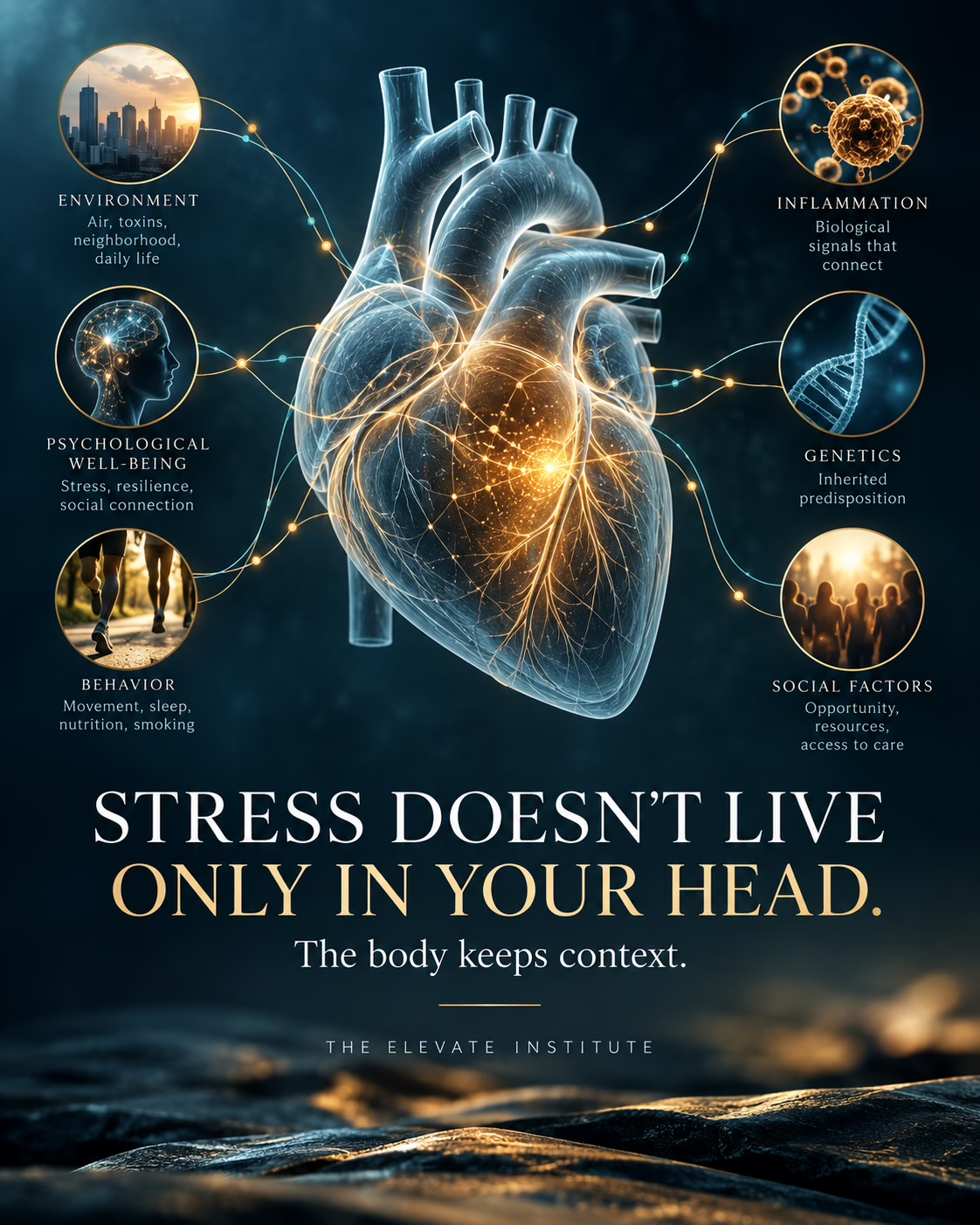
Chronic Stress Doesn’t Live Only in Your Head:
What New Heart Research Reveals About the Biology of Daily Life
There is a phrase I would happily retire from health conversations:
“It’s just stress.”
Not because stress explains everything.
It absolutely does not.
I want to retire it because the word just quietly turns something complex into something imaginary.
Stress becomes the consolation prize diagnosis. Your tests look normal. Your symptoms are inconvenient. Life is difficult. Therefore: probably stress.
Then we commit an equally sloppy error in the opposite direction and claim that stress causes practically every disease known to humanity.
Neither position is intelligent enough.
New cardiovascular research gives us a much more interesting way to have this conversation.
Researchers from Imperial College London and the MRC Laboratory of Medical Sciences analyzed data from nearly 480,000 adults in the UK Biobank. Their study, published September 18 in the European Journal of Preventive Cardiology, examined inflammation, genetics, heart structure, cardiovascular outcomes, psychological distress, socioeconomic circumstances, and established lifestyle risks.
The headline result is dramatic.
People with the highest levels of inflammation—the top 20%—had a 43% higher risk of heart attack and stroke than people in the lowest 20%. Higher inflammation was also associated with structural differences in the heart, including thicker walls, smaller chambers, and poorer filling.
But the number is not actually the most interesting part.
The connections are.
First, what did the researchers actually measure?
This matters because “stress damages your heart” is already racing around the internet.
The researchers did not simply ask 480,000 people whether they felt stressed and then inspect their hearts.
They used a blood marker called glycoprotein acetyls, or GlycA, as an indicator of systemic inflammation. They combined that information with cardiovascular imaging, genetic data, health outcomes, lifestyle factors, psychological measures, and socioeconomic information from UK Biobank participants.
Higher inflammation was associated with psychological distress and socioeconomic disadvantage.
It was also associated with familiar cardiovascular risks such as smoking and excess body fat.
Genetics mattered too. Some people appeared more susceptible or resilient to inflammatory effects depending upon genetic variation. Researchers also identified inflammatory proteins from interleukin-1 and TNF families as potential contributors to the cardiovascular changes they observed.
That is considerably more sophisticated than:
stress → inflammation → heart attack.
And that distinction is important.
The categories are ours. The physiology is shared.
We like tidy health categories.
Mental health over here.
Cardiovascular health over there.
Lifestyle in another box.
Genetics gets its own box.
Socioeconomic circumstances belong to public health.
Environment gets discussed somewhere else.
Then we wonder why people with complicated chronic health concerns rarely fit neatly into any one of them.
The body never signed that organizational chart.
Your nervous system does not stop interacting with your cardiovascular system because one is being discussed in a therapist’s office and the other in a cardiologist’s office.
Your food choices do not exist independently of income, geography, stress, culture, time, sleep, family, appetite, education, and access.
Your genes do not operate outside an environment.
And your environment does not encounter a genetically identical population.
That is what makes this study so compelling.
Not because it proves everything is connected.
Science does not need that slogan.
It demonstrates something more useful: multiple categories of lived experience can converge on measurable biological pathways.
That is where True Holistic Healing becomes considerably more rigorous than the familiar “mind-body-spirit” shorthand.
The point is not that there are three parts of you requiring three kinds of care.
The point is that there was only ever one you.
Inflammation is not the villain of the story
This is another place where wellness language gets careless.
Inflammation is frequently discussed as though it were toxic sludge accumulating in the body.
It isn’t.
Inflammation is part of normal immune defense and repair.
You want an inflammatory response when biology requires one.
The concern is persistent or dysregulated inflammatory activity in contexts where it contributes to disease processes.
In this study, people with persistently higher inflammatory levels had greater cardiovascular risk, even among those without pre-existing cardiovascular disease.
That does not mean you should begin hunting for an “anti-inflammatory detox.”
Nor does it mean every person experiencing chronic stress has silently developed heart damage.
The study helps illuminate population-level relationships. It does not diagnose the person reading this article.
That distinction is where responsible health education lives.
The 43% number needs context
Health headlines love percentages because percentages travel faster than nuance.
So let’s slow this one down.
The researchers found that people in the highest fifth for inflammation had a 43% greater relative risk of heart attack and stroke compared with those in the lowest fifth.
That does not mean:
“High inflammation gives you a 43% chance of a heart attack.”
Relative risk compares groups. Individual cardiovascular risk still depends upon age, blood pressure, cholesterol, smoking, diabetes, family history, existing disease, and many other factors.
This is why one biomarker should not become another health identity.
A person is not their GlycA level any more than they are their cholesterol, ferritin, weight, cortisol, or HRV.
Measurements matter.
Meaning requires context.
What chronic stress actually teaches us
The current media conversation is focusing heavily on stress, and there is a legitimate reason.
Psychological distress was associated with higher inflammation in the study. So was socioeconomic disadvantage.
That second finding deserves much more attention than it will probably receive.
“Reduce your stress” is remarkably easy advice to give someone whose stress is created by unsafe housing, financial insecurity, caregiving burden, discrimination, food insecurity, unstable employment, social isolation, or lack of access to healthcare.
A breathing exercise may be useful.
It is not economic policy.
And yet those external conditions still arrive inside a biological human being.
This is where a truly holistic framework must resist becoming an individual-responsibility machine.
If environment matters, then health is not exclusively a matter of personal discipline.
If social conditions matter, then some health interventions belong upstream of the individual.
If genetics matter, identical exposures may not create identical effects.
If behavior matters, personal agency still matters too.
These truths can coexist.
Holistic thinking should make our explanations more precise, not more mystical.
Your surroundings are not outside your health
Here is the distinctly Elevate question I think this research earns:
What if some of what we call “background” is actually participating in the biology?
The difficult relationship.
The twelve-hour workdays.
The neighborhood where walking safely isn’t realistic.
The financial pressure.
The sleep sacrificed to caregiving.
The cigarette used to regulate distress.
The food available when time and money are scarce.
The genetic vulnerability you did not choose.
The supportive friendship that makes the hard week survivable.
We tend to classify these as context around the health problem.
Perhaps context is sometimes part of the health problem.
That doesn’t mean every unpleasant life circumstance causes disease.
It means the border we draw between “life” and “health” may be much more artificial than biology’s border.
Please don’t turn this into another cortisol panic
Whenever research links psychological experience to physical disease, a predictable marketplace appears five minutes later.
Test your cortisol.
Lower your cortisol.
Buy the anti-inflammatory supplement.
Eliminate the inflammatory food.
Fix your nervous system.
Regulate harder.
We can do better than that.
This study measured GlycA and investigated multiple inflammatory proteins, genetics, imaging findings, and environmental factors. It did not establish that a consumer cortisol test predicts cardiac remodeling. It did not prove that one supplement reverses the pathway. It did not demonstrate that eliminating a particular food prevents the observed outcomes.
Do not convert complex research into a product pitch.
The useful response is much less glamorous:
Know your cardiovascular risk factors.
Don’t smoke.
Move regularly within your ability.
Address blood pressure, blood sugar, and lipids appropriately with qualified care.
Eat in a way that supports cardiovascular health.
Sleep.
Build and use social support.
Address persistent psychological distress.
And recognize that some forms of chronic strain require structural solutions, not another item on your self-care checklist.
The most holistic question may also be the most practical one
When someone arrives with a chronic health concern, we often begin with:
What is wrong?
Sometimes that is exactly the question medicine needs to answer.
But there is another question that deserves to sit beside it:
What has this person been adapting to?
Not as a diagnosis.
Not as an assumption that adversity caused the illness.
…As context.
- What has changed?
- What has persisted?
- What is physiological?
- What is environmental?
- What is behavioral?
- What is relational?
- What has actually been measured?
- What remains unknown?
- Which risk factors are modifiable?
- Which conditions require medical treatment?
- Which burdens cannot reasonably be solved by the individual alone?
That is a richer health conversation.
And interestingly, modern research is making it harder—not easier—to pretend these questions belong to separate worlds.
If you want a place to begin observing your own patterns without prematurely deciding what they mean, The Elevate’s Compass is designed for exactly that first movement: curiosity before conclusion.
Because your life does not happen around your body.
It happens through it.
Discover more from The Elevate Institute
Subscribe to get the latest posts sent to your email.


