


You Slept Eight Hours. But What Happened During Them?
There is something almost accusatory about being tired after eight hours of sleep.
You did the thing.
You went to bed. You stayed there. Your alarm confirms that a respectable number of hours passed. Yet you wake up feeling as though your body spent the night doing paperwork instead of restoring itself.
The standard response is usually to interrogate the number.
Did you really get eight hours? Maybe you need nine. Maybe seven is your magic number. Perhaps your watch says your REM was terrible. Perhaps another app has awarded you a sleep score of 63 and sent you into breakfast wondering what, exactly, you did wrong while unconscious.
A large new study gives us a better reason to stop treating sleep as merely a quantity.
Researchers writing in PLOS Medicine examined real-world sleep patterns from 95,559 middle-aged and older UK Biobank participants who had worn wrist accelerometers. Instead of looking only at total sleep duration, researchers used an algorithm to estimate REM, light and deep sleep, along with sleep regularity and periods of wakefulness after sleep began. They then examined how those patterns were associated with the subsequent development of more than 1,000 health conditions over a median follow-up of 8.9 years. PubMed
The results are fascinating.
They are also very easy to oversell.
The Headline Is Not “Get More REM and Prevent 83 Diseases”
After stringent statistical correction, researchers found 156 associations between sleep characteristics and incident disease. Higher estimated REM sleep was associated with lower risk across 83 disease outcomes, while higher amounts of deep sleep were associated with lower risk across seven. Greater sleep irregularity and more wakefulness after sleep onset were associated with increased risk for several conditions. PubMed
Sleep duration also mattered, but not in a simple “more is always better” fashion. Researchers found nonlinear associations between sleep duration and 86 disease phenotypes, with the lowest-risk duration for most of those outcomes falling within a six-to-eight-hour range. People sleeping fewer than five hours showed the broadest pattern of adverse associations. PubMed
Before we turn that into a prescription, there are several important brakes.
First, this was an observational study. It can identify relationships; it cannot establish that one sleep pattern caused or prevented a disease.
Second, the sleep stages were estimated from a wrist accelerometer using the SleepNet algorithm. That is impressive technology, but it is not the same thing as measuring sleep in a clinical sleep laboratory with polysomnography, where brain waves, eye movements, breathing and other physiological signals can be directly monitored.
Third, a seven-day period of wearable measurement was used to characterize sleep patterns that were then related to health outcomes over years.
So this research does not give us permission to announce that increasing your REM percentage by five points will prevent disease.
It gives us something subtler and, I think, more valuable.
Sleep has architecture.
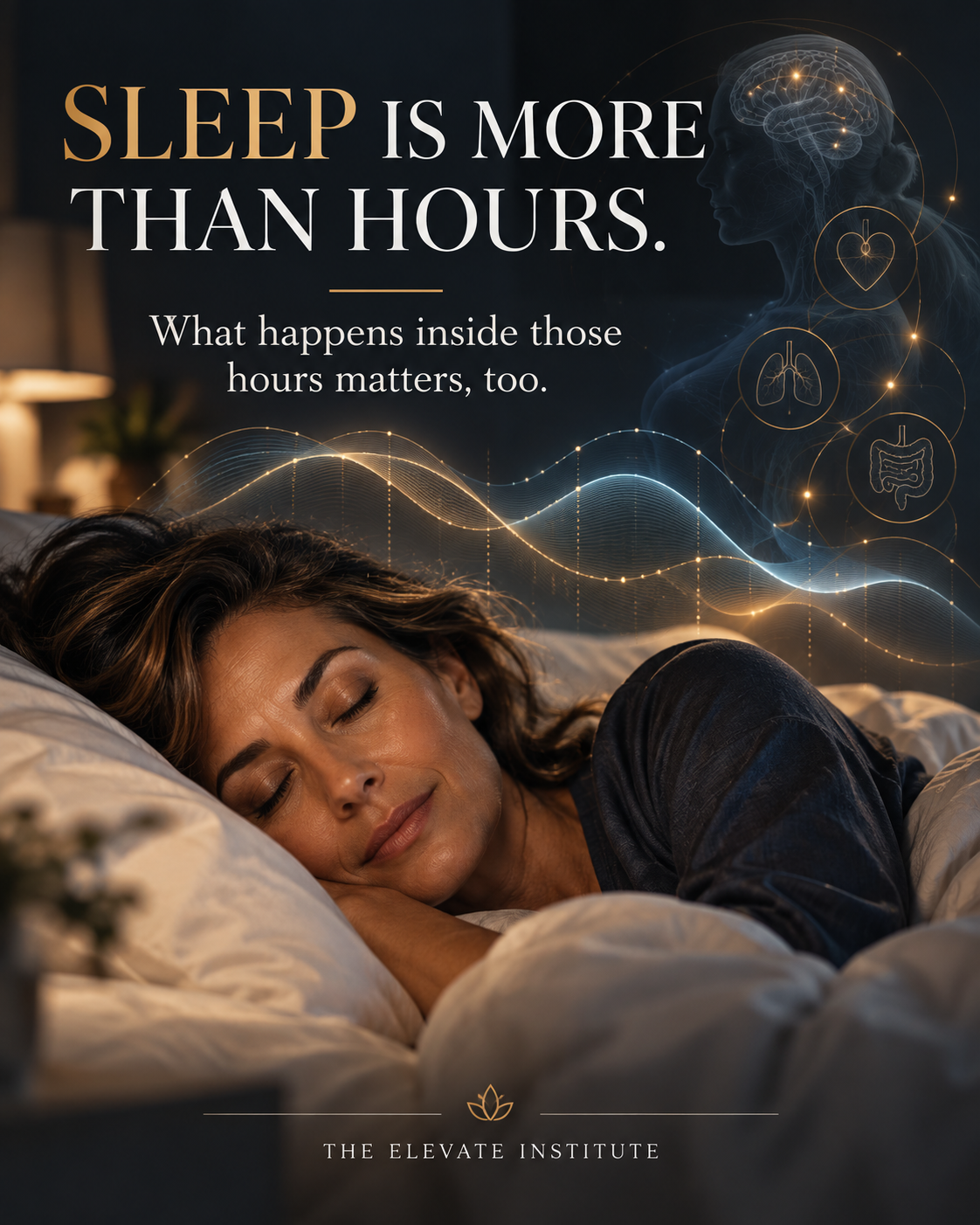
The hours matter. What happens within those hours matters too.
Eight Hours Is a Measurement, Not an Explanation
This distinction becomes particularly important when someone says:
“But I sleep eight hours and I’m still exhausted.”
That sentence contains useful information. It does not contain a diagnosis.
According to the Centers for Disease Control and Prevention, signs of poor sleep quality include difficulty falling asleep, repeatedly waking during the night and feeling sleepy or tired even after getting enough sleep. Common sleep disorders include insomnia, restless legs syndrome, narcolepsy and sleep apnea. CDC
That means “I got eight hours” may be the beginning of the investigation rather than its conclusion.
Were those hours continuous?
Do you snore or stop breathing?
Do you wake repeatedly?
Are your legs restless?
Are you sleeping on a stable schedule?
Are you waking restored?
Are medications, alcohol, pain, hot flashes, blood-sugar fluctuations, anxiety or another medical condition interfering with sleep?
And there is another possibility worth considering:
Perhaps sleep itself is not the entire explanation for why you are tired.
This is where the conversation becomes whole-person rather than sleep-hack theater.
Sleep Is Not a Separate Department in the Body
We speak casually about “fixing sleep” as though sleep lives in its own little room.
It does not.
Sleep participates in cardiovascular regulation, metabolic health, cognition, emotional processing, immune function and recovery. Those systems, in turn, can influence sleep.
The CDC notes, for example, that blood pressure normally falls during sleep. Sleep problems can interfere with that pattern. Sleep apnea repeatedly disrupts breathing and oxygen delivery and is associated with increased risk of high blood pressure, heart attack and stroke. CDC
This is one reason the new PLOS Medicine paper is so interesting. The researchers did not find sleep connected neatly to one disease category. Sleep characteristics were associated with outcomes across multiple physiological systems. PubMed
That does not mean sleep causes everything.
It means sleep belongs to the whole organism.
That distinction is the difference between systems thinking and a wellness slogan.
Your Wearable Knows Something. It Does Not Know Everything.
This research also arrives at an interesting cultural moment.
Millions of people now wake up and ask a wristwatch how well they slept.
I actually think objective personal data can be tremendously useful. A wearable can reveal patterns our memories are terrible at detecting: inconsistent bedtimes, frequent awakenings, changes in resting heart rate, altered activity or a recurring relationship between behavior and recovery.
But a wearable becomes less useful when the score becomes the explanation.
Consumer sleep trackers generally infer sleep from combinations of movement and physiological signals. They are not performing the same measurement as a clinical sleep study.
Even the sophisticated research behind this new paper relied on algorithmically derived sleep stages from wrist accelerometry. The authors themselves identify the observational design as a central limitation. PubMed
So if your watch tells you that you had 47 minutes of REM sleep last night, resist the temptation to turn that number into a medical diagnosis.
Look for patterns.
Ask better questions.
Use data as evidence—not as an oracle.
Women Are Especially Likely to Know That “Enough Hours” Isn’t the Whole Story
The newest U.S. sleep data make another distinction worth noticing.
A 2026 report from the National Center for Health Statistics found that 30.5% of U.S. adults slept fewer than seven hours on average in 2024. Men and women had nearly identical rates of short sleep.
But their experience of sleep was not identical.
Women were more likely than men to report trouble falling asleep, more likely to report trouble staying asleep and less likely to wake feeling well-rested. Among women and men combined, 18.1% of adults reported trouble staying asleep most days or every day; for women, that figure was 21.4%. CDC
That is exactly why an hours-only conversation misses so much.
Two people can both report seven and a half hours of sleep while having very different nights.
And very different mornings.
Restoration Is an Outcome, Not a Bedtime Achievement
This is where I would change the question entirely.
Instead of asking only:
How many hours did I sleep?
Ask:
How well am I restoring?
That question opens more doors.
Do you wake with usable energy?
Can you sustain ordinary activity?
How does your body respond after exertion?
How clearly can you think?
Does your energy collapse at predictable times?
Are you compensating with caffeine simply to reach baseline?
Do you require dramatically more recovery than you once did?
None of those answers diagnoses a condition. Together, however, they describe the lived pattern far better than an isolated number on a sleep app.
This is central to True Holistic Healing.
Holistic does not mean assigning every symptom to stress, energy or some invisible root cause. It means recognizing that a human being does not divide herself into the same categories we use to organize health information.
Sleep affects the day.
The day affects sleep.
Metabolism, emotional strain, physical illness, relationships, behavior, environment and physiology are already participating in the same life.
The job is not to force all of them into every explanation.
The job is to determine which ones matter here.
When “I’m Tired” Needs More Than Sleep Hygiene
Persistent exhaustion despite adequate opportunity for sleep deserves investigation.
If you regularly have difficulty sleeping, repeatedly wake, experience excessive daytime sleepiness, snore heavily, have witnessed pauses in breathing, or continue feeling unrefreshed despite adequate sleep time, a qualified clinician can help evaluate whether a sleep disorder or another health condition is involved. The CDC specifically recommends speaking with a healthcare provider when sleep problems are regular and notes that sleep studies may be used to evaluate sleep disorders. CDC
That medical boundary matters.
Not every tired person needs another supplement.
Not every tired person needs a sleep study either.
They need the right investigation for their pattern.
The Better Question Comes After the Sleep Score
If your medical sleep evaluation is appropriate and you are still trying to understand the broader physiological context behind poor energy and recovery, this is where REVEAL can become useful.
REVEAL uses hair mineral analysis to examine your individual mineral pattern as one piece of a larger physiological picture. It is not a sleep study. It does not measure REM or deep sleep, diagnose insomnia or sleep apnea, or determine whether you are at risk for the diseases examined in this research.
Its role is different.
It helps us stop prescribing from a generic symptom and start gathering information about the person experiencing it.
That is a distinction I keep returning to because personalization is increasingly being confused with buying more personalized-looking products.
Real personalization begins by becoming more specific about the question.
If you sleep eight hours and wake restored, wonderful.
If you sleep eight hours and wake exhausted, the number has done its job.
It has told us that simply adding another hour may not be the question worth asking.
Now we investigate what happened inside those hours—and what is happening in the person who lived them.
References & Documents Cited
Luo J, Liu R, Yin J, Cao W, Sun S, Chen R. Accelerometer-derived real-world sleep stages and risk of incident diseases: A UK Biobank cohort study and phenome-wide association analysis. PLOS Medicine. 2026;23(9):e1005213. DOI: 10.1371/journal.pmed.1005213. PubMed
PubMed record and study abstract
Centers for Disease Control and Prevention. About Sleep. May 15, 2024. CDC
CDC sleep guidance
National Center for Health Statistics. Short Sleep Duration and Sleep Difficulties Among Adults: United States, 2024. NCHS Data Brief No. 559. April 2026. CDC
NCHS 2026 sleep data brief
Centers for Disease Control and Prevention. About Sleep and Your Heart Health. CDC
CDC sleep and heart-health guidance
FAQs: Can you sleep eight hours and still have poor-quality sleep? Yes. Repeated waking and continuing to feel tired despite adequate sleep are signs of poor sleep quality identified by the CDC. CDC
Does more REM sleep prevent disease? This study cannot establish that. Higher estimated REM was associated with lower incidence of many conditions, but the study was observational and cannot establish causation. PubMed
Can a smartwatch accurately diagnose my sleep problem? Consumer or wrist-derived data can provide useful patterns, but the new study itself used algorithmically inferred sleep stages rather than clinical polysomnography. Persistent sleep problems may require clinical evaluation or a sleep study. PubMed
Do women have more trouble sleeping than men? In 2024 U.S. survey data, women and men had similar rates of short sleep duration, but women more often reported trouble falling asleep, trouble staying asleep and not waking well-rested.
Discover more from The Elevate Institute
Subscribe to get the latest posts sent to your email.